
Forty years ago, on a late sunny afternoon in March, I left school with an overwhelming sense of relief. I had just completed my ICSE exams, and for the first time in weeks, I didn’t have to go home and cram for exams. I suddenly seemed to have a limitless supply of time with nothing to do. Freedom!
The “Indian Certificate of Secondary Education” examination marks the culmination of high school (tenth grade) for a subset of students in India. I had just graduated from high school.
My introduction to the exam came via my older brother and my cousins. As veterans, they exhibited the scars of this exam, reminiscing about the extensive portions, the vagaries of the papers, and the eccentricities of the evaluators. When I joined my school in fourth grade, the ICSE exam was a distant bridge to cross—not even on our radar. However, we got used to the routine, when, once a year, approximately in February, we were told to avoid the area around our concert hall where the ICSE exams were conducted. We trooped past silently in the morning as anxious tenth graders studied feverishly.

Our teachers started the faint drumbeat of ICSE when we entered seventh grade. For Math and Science, we would be tested on material taught from 7th grade onwards. Even though we had four years to go, some teachers would try to put the fear of God in us by invoking the looming specter of the “ICSE” exam. Perhaps no other teacher spoke more about ICSE than Mr. Andrade. Over the years, he taught us English, Geography, and Economics. Each time he mentioned the exam, he would pause, and his eyebrows would arch up to drive home the importance of the exam to us. Years later, as I watched Mr. Rumbold look up and point upstairs while talking about the “Board” in the British comedy Are You Being Served?, a vision of Mr. Andrade and ICSE would pop into my mind.

Even though the exams were administered at the end of 10th grade, one usually committed to them as early as first grade. When I was growing up in India, there were generally three boards that reflected different strands of education. CBSE (Central Board of Secondary Education) was meant for the children of personnel in the armed forces and central (federal) government officials who were likely to be transferred frequently. It maintained a consistent syllabus across its schools to make it easier for students to adapt when their parents were posted to different places within the country.
As opposed to the central board, each state had its own board of education, and the syllabus and standard of education varied from state to state. Each state has its own official language; this is where CBSE maintains uniformity by making Hindi the second language across the country. The ICSE board (or CISCE, for the purists) stood out as an outlier. It also provided a consistent syllabus and was established in 1958. Before this, exams were administered by the University of Cambridge. The ICSE board was designed to impart the same standard of education with a national flavor. Since very few schools administered both the State and ICSE exams, one’s choice of school often determined which exam one would take.
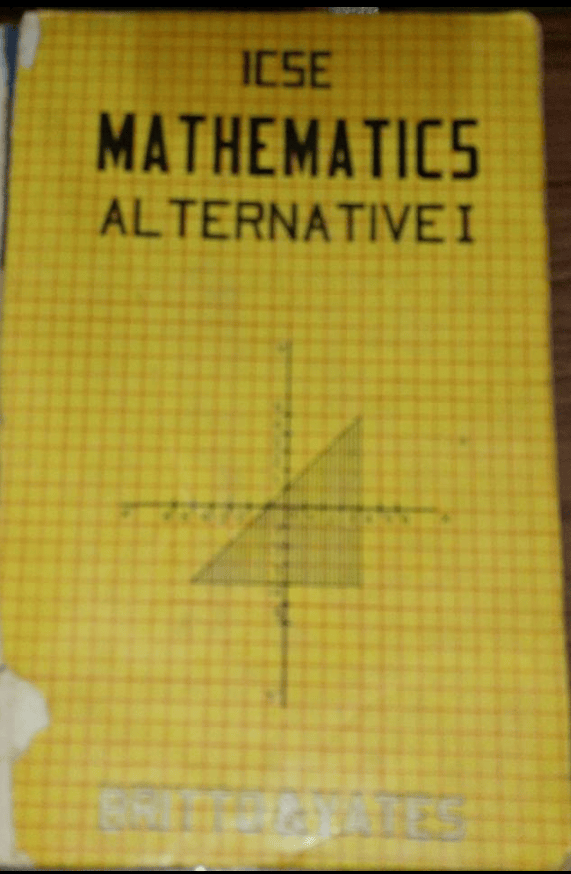
The legacy of the Cambridge system was also evident in some of the textbooks we used. When I took the exam in 1985, most of our textbooks were written by Indian authors and published in India. However, I still referred to older textbooks, such as Holderness and Lambert for Chemistry, Monsoon Asia for Geography, and Abbot O Level Physics. These textbooks were printed in the UK. Closer home was the textbook written by our Math teacher, Mr Yates!
The syllabus was characterized by extensive portions. In Geography, for example, we had separate textbooks for Physical Geography and Regional Geography. We studied maps extensively, and the exam tested our map-reading skills by requiring us to identify features on topographic maps.
In my mind, the History syllabus roughly spanned three areas. The first covered the period from the Indus Valley Civilization to the First Battle of Panipat in 1526. The second ranged from the First Battle of Panipat to India’s independence in 1947. The third focused on World History. But that wasn’t all—there was also social, religious, and cultural history, along with a separate textbook on Civics.
While we studied much of this material, the exam offered considerable choice, allowing us to focus on two of the three areas of political history. We studied World History in seventh and eighth grade and Indian History in detail in ninth and tenth grade, so I naturally gravitated toward Indian History.
The pace picked up, so to speak, in ninth grade. We watched our seniors prepare for the exam, knowing we were next in line. The handling of the syllabus was uneven. While we continued to cover new material in all subjects until the end of tenth grade, we completed the core of the English syllabus by the beginning of tenth grade. This included twenty poems from a textbook called Panorama, short stories from a lovely book called Tales from Far and Near, and an unabridged version of Shakespeare’s The Merchant of Venice. We also had Robert Louis Stevenson’s Treasure Island, which we finished early in tenth grade.

By November, the pressure was on. Our prelims took place sometime between late November and early December. The only thing I remember from my prelims is blanking out during my Math exam. My uncle had passed away the previous day, and after a sleepless night, my mother left early in the morning for Bombay. I was disoriented as I took the exam—but I squeaked through.
And yes, I remember reading Freedom at Midnight during my prelims and being completely spellbound by the book. We had covered a fair amount of material in our history class, but this was written as a free-flowing narrative, unlike the dry material in our textbooks.
At that time, results were declared in points. Scoring over 90% in a subject earned one point, 80% to 90% earned two points, and so on. The fewer the points, the better your performance! A perfect score was six points—one point in each subject. But that was a bridge too far.
For many of us in the South, Hindi was the nemesis. We spoke our regional state language or English with friends. If Hindi wasn’t your native language, the only way to pick it up was through Hindi movies, songs, and cricket commentary on the radio. Television serials were another option. But it’s difficult to excel in an exam that tests language skills when you don’t speak the language daily. And so, many a topper who scored one point in every other subject was stymied by Hindi, ending up with eight or nine points instead.
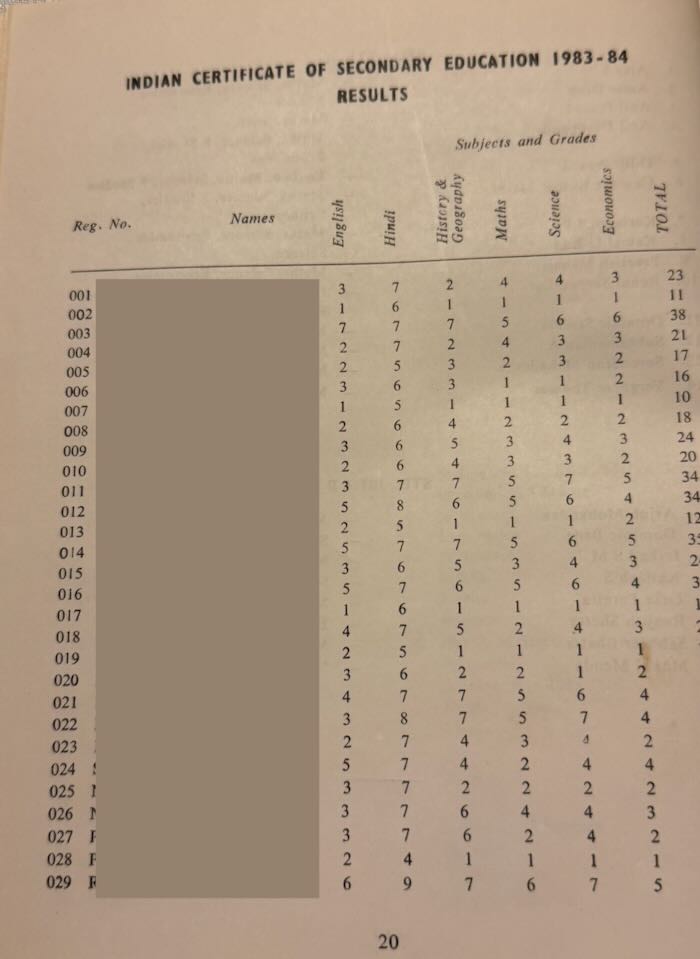
There was one exception, though. As far as I know, the last six-pointer from my school was Subir Sachdev, from the batch of 1976. He managed that elusive one point in Hindi! Today, Subir is the Herchel Professor of Physics at Harvard University.
Stalwarts like Subir stood out in school—they became the stuff of legends and lore. Names like Joy Thomas (batch of 1977) and Rahul Sarpeshkar (batch of 1984) carried the same aura of brilliance. I remember walking past the concert hall during the ICSE exams for the batch of 1983 when I was in eighth grade. It was the Math exam, and I noticed a slight commotion—a group of students had gathered in one corner of the garden. As I drew closer, I realized they were asking questions and having problems solved by Rahul, who was a year junior to them!
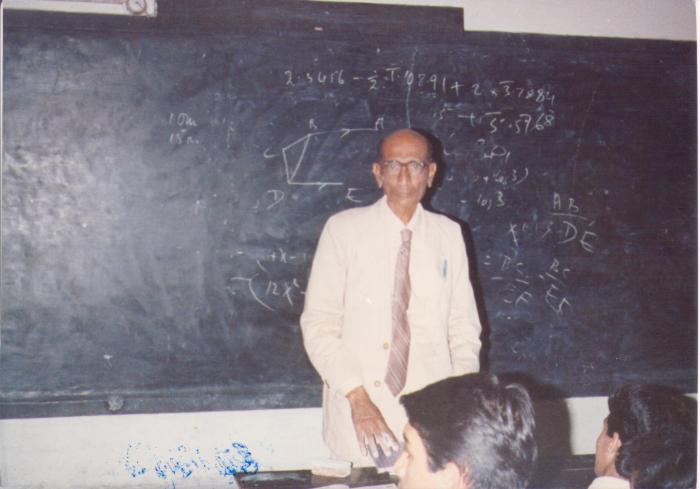
A word about our teachers. They were experienced and many of them were invested in the students. The teachers who stand out in my memory are the mercurial Mr Chatterjee who lived and breathed Chemistry to the exclusion of everything else. The taciturn Mr. Yates who had taught Math at our school for forty-plus years. He had a wry sense of humor! Mr Cyrill Rodrigues had a rough start with our batch but then went on to earn our trust. Mrs Renu Kumar took it upon herself to raise our collective Hindi skills and conducted special classes during lunch breaks and study holidays.
School ended in the first week of February, giving us a little over two weeks of study holidays. I crammed feverishly for the upcoming exams. Practicals preceded the theory exams. The exams themselves were a blur—two papers a day, each lasting two hours. From what I recall, they started on a Monday, with one intervening weekend, and were over by the following Monday.
While most of the exams are hazy in my memory, one moment stands out vividly. On the weekend before our last exam, India defeated Pakistan to win the final of the Benson & Hedges World Championship of Cricket! We didn’t have a TV at home, so I listened to the commentary on the radio while studying and then rushed to my neighbor’s house just in time to watch India score the winning runs.

I spent a blissful couple of months in Bombay after my exams. In that time, I grew three inches in height and put on 15 pounds! A carefree life and plenty of rich food do wonders for a growing boy.
Our results came out in due course, and I ended up doing reasonably well. Hindi, as expected, was our nemesis, but the real surprise was English. The highest score in our school was in the mid-seventies—shocking, considering that students from other schools in Bangalore had scored in the nineties. It was all the more perplexing because my batch had some incredibly talented wordsmiths, including Shankar Vedantam who later embarked on a literary career and is currently the host of the popular podcast The Hidden Brain. To add insult to injury, the school declined to award the Gold Medal, traditionally given to the topper—in our batch, Krishna Bharath—as well as the awards for the top scorers in each section.
We learned the hard way that while exams may be objective, grading is always subjective! You could have a bad day and screw up, or the examiner could have a bad day and you might suffer the same fate. And yes, our results were posted on the school notice board for all to see—and in case you missed them, they were also published in our School Annual at the end of the year. Depending on how you performed, it was either the Hall of Fame or the Hall of Shame!

The logical continuation in the ICSE stream would have been to move on to the ISC board for our eleventh and twelfth grades. However, very few students chose that path. The ICSE and ISC were notoriously difficult to score in comparison to the local state boards, and students who completed their ISC found themselves at a distinct disadvantage when applying for professional courses.
So, like many others, I switched to the state board for my twelfth grade. The curriculum was much easier, but the stakes were significantly higher. Things seem to have changed now. The syllabus has been trimmed down, and I hear of ICSE scores soaring into the high nineties. Either the collective intelligence has skyrocketed—which would be a fantastic development—or the exams have simply become easier to score in.
My daughter’s experience in the US has differed significantly from mine. There are no single make-or-break exams like the ones I had in India. Instead, the Grade Point Average (GPA) is calculated over four years. Students have much more flexibility in selecting subjects, with varying levels of difficulty available for each, allowing them to choose the level that suits them best. The system is highly decentralized, and the coursework includes a substantial amount of project work.
However, the whole university admission process in the US is fairly subjective. In India, exams are mostly objective, and university admissions are based on the rank one scores in these exams. The focus is entirely on a single exam, and if you have one bad day, your chances are ruined. The Indian system has its flaws, as students primarily study for the exam, with understanding the material often taking a back seat. Additionally, you are competing for a limited number of seats, with 50% reserved for affirmative action.
When I see websites like Khan Academy and tools such as ChatGPT now, I can’t help but regret that these weren’t available to us. If we didn’t understand the material in school or couldn’t solve a problem over the weekend, we had to wait until we returned to school to ask a classmate for help. We relied on class notes and textbooks. I had a few extra textbooks that belonged to my cousins and my brother lying around at home, and I would occasionally refer to them or solve problems from them to grasp a concept better.
We had no distractions back then—no internet, no video games, no cable TV. We didn’t even have a telephone or TV at home, so if I needed a break from my studies, I would read a magazine or a book or go outside to play with my friends.
For all the hype surrounding our ICSE exams, the aftermath was a bit of an anti-climax. The top ten percentile and the bottom ten percentile more or less ended up at the same college. As with any exam, many of the students who performed well in the ICSE went on to excel in other exams and in their professional careers. On the other hand, many who didn’t do well in the ICSE went on to have fantastic careers or became successful entrepreneurs. The exam tested one’s ability to memorize large amounts of information and solve theoretical problems. However, life requires other skills that are not taught in schools and cannot be measured by exams.

Surprisingly, no one taught us how to learn. We were often told to “focus, concentrate, and study hard,” but no one explained how to focus or concentrate. Given how rapidly things change in my profession, I have to keep reading and learning to stay up to date. It gets more challenging over time, and I’m always exploring concepts like the Feynman technique, ultra-learning, and others to see if they can make a difference. So far, I haven’t had a “eureka” moment.
When I reflect on my ICSE exams, I remember using a self-taught mind map technique with mnemonics to retain information, especially in History, Geography, and Economics. I realized early on that if I could organize the information and use mnemonics (including mnemonics for mnemonics), I could remember entire chapters. Of course, this was just a tool to assist in recall; I still had to put in the hard work to study the material.
The ICSE exam did differ from other boards in certain respects. It aimed to be innovative within the constraints of the Indian educational system. For one, each batch had to study a Shakespearean play in its entirety. My batch studied The Merchant of Venice. I can still recite the opening lines from Act 1, Scene 1, and a few other lines from the play.
The composition section of the English paper featured a picture based on which we had to write an essay. For our geography classes, we had to procure topographic sheets from the Survey of India. We were taught map-reading skills, a skill I still rely on occasionally when using apps like Gaia while hiking.
The Religious and Cultural History paper required us to identify two monuments based on their pictures and then answer a series of questions about them. It was a great way to learn about the rich cultural heritage of India. Woe betide you, though, if you mistook the Gopuram of the Brihadeeshwara Temple for another temple in South India.
The Religious and Cultural History section also provided a solid overview of the tenets of various religions. The Botany textbook we used was prescribed for undergraduate degree students in India, which made the subject feel more in-depth than typical school-level material.
Each student had to participate in an extracurricular activity during the final two years of school. While the syllabus offered a wide variety of choices, we were limited by what our school provided. I was a member of the Chemistry Club.
So, forty years on, what does the ICSE mean to me? The fact that I’m reflecting on it now might give the impression that I’m a nerd who loves examinations, but that’s not quite the case. I think there’s a tendency to look back at one’s life through rose-tinted glasses. At the time, it felt like the biggest obstacle in my life. And as with everything else, when I look back at the past, things seem easier in comparison.
As mentioned earlier, exams generally test theoretical knowledge within a confined syllabus. Life, on the other hand, has no such constraints and tests you arbitrarily, often with harsh consequences. Every exam has a definite answer to a question, but that’s not how life works. While examinations have consequences, it is easy to hang one’s self-esteem on the results, with sometimes deleterious consequences.
The uncomfortable thought has crossed my mind that this exam is the legacy of Macaulay’s infamous 1835 “Minute on Indian Education,” in which he advocated for creating, in his words, “a class of persons, Indian in blood and colour, but English in taste, in opinions, in morals, and in intellect.” He sought to create a class of Indians who would help the British administer their colony. I don’t think this thought crosses the minds of parents. For them, ICSE schools provide a well-rounded education for their children, and that demand continues to grow.
Regardless, it was the first significant exam in my life, and although I didn’t believe it at the time, perhaps the most interesting. I think it provided me with the best grounding in the general sciences and other subjects. From that point on, everything became narrower, albeit in more depth. Our main source of information back then was the daily newspaper. When I look back, I realize that I could flip to any section in the newspaper and have a decent understanding of what was going on.
Elections, parliamentary proceedings, amendments, and bills? No problem—our civics lessons had prepared us well for that. Earthquakes, typhoons, solar eclipses, and weather patterns? Covered in Physical Geography. Trouble in Europe or Africa, border issues in the Himalayas, rivers in spate, cricket matches in Australia? I could immediately point to those locations on the map, thanks to Geography again. Falling demand, supply issues, bonds, debentures, banking matters? Not entirely clear, but the economics I studied at least gave me a general understanding. The Four Noble Truths, Hijrah and Hegira, Karma, Moksha, Nirvana, and the five symbols of Sikhism? We studied all that in Religious and Cultural History. Controversies about Tipu Sultan, Aurangzeb, Shivaji, or any other ruler from history? I had the dates, dynasties, territorial conquests, and reforms all at my fingertips. The Round Table Conferences, the Government of India Act, the Khilafat Movement, Jallianwala Bagh, and its role in Indian independence? It was drilled into our heads during History classes. Not bad for a sixteen-year-old!
Later this year, I will meet my classmates for our high school fortieth-year reunion. I doubt the ICSE exams will come up, and if they do, they will be in jest to rag someone. We will reminisce about our days in school and revel in our shared memories—of classmates remaining and of classmates lost. And if perchance I am lost in thought and a classmate asks me what gives, I might reply:
In sooth I know not why I’m so sad
It wearies me, you say it wearies you
But how I caught it, found it or came by it
What stuff ‘tis made of, whereof it is born
I am yet to learn.
And the friend might remark with a gleam in his eye,
“Antonio, Merchant of Venice!”
Or his eyes might cloud over
and he might ask me what I’ve been drinking!
The pictures of my school are hazy as these are screen grabs from a video. The school building was demolished some twenty years ago, a new building stands in its place
Splendidly written. Enjoyed living the description you have so vividly painted once more.
Thank you
Thank you for the kind words, Uttam!
Beautiful!🥰
Thank you, Rashmi!
RN, your memory is staggering and your writing ✍️ is stellar as always.
I cannot believe that Mr. Hartley (?) Yates taught me around 1970 and was still teaching you 15 years later. Apparently, none of my other teachers lasted that long.
Cliff4noronha@gmail.com
+1.240.750.3331 WhatsApp
Thanks, Cliff! Yes Papa retired after our batch. Mr Alvarez and Mr Luke D’Souza also had long careers!
Loved reading every bit of it
Read it again and again
It’s just transported me down the memory lane
Thank you
Hi Joe,
Thanks for bringing back memories. That is what I felt & feel till date.
SJBHS made me whatever I am today. I love my school.
Well written Joe, I lapped up every sentence of yours with happiness & fond memories.
Cheers,
Hi
Amazingly written
Just curious. You mentioned the papers used to start on Monday and within a week got over. This seems scary and impossible by today’s standards. So does it mean every day 2 papers continuously without a gap?
Also i would like to mention why scoring in ICSE now has become much easier.
ICSE now has bifurcated syllabus ( adopted from year 1995 ) . So 10 th class portion only is assesesed at the end of the exam unlike 1985 when combined grade syllabus of 9th and 10 th was assessed.
Also mathematics used to have 2 papers earlier, which after 1994 was reduced to 1 paper. The practical questions also were set by the council unlike the present time when they are assesesed internally . Syllabus has been cut down tremendously.
Thank you, Dr Jha. Yes, 2 papers a day without any gaps! It was like ripping off a bandaid and perhaps good in the sense that it got over quickly!
Hi.
It’s a far fetched question
By any chance are ICSE 1984 question papers still available with you?
Thank you
Sorry, I don’t!