
When the rare Pankaj Mullick song played on the radio in the 1970s, we would stop whatever we were doing and listen to the song. After the song had ended, my dad would remark wistfully, “That was a great song, but not like his songs from Yatrik. Those songs were something else.” Those were our pre-cassette player days, when we did not have the luxury of playing the songs we desired but had to rely on the radio. The mystique of “Yatrik” would grow just a little bit more in my mind.
Pankaj Mullick was the legendary composer of Bengali and Hindi film music. He was an equally good singer, and his film career spanned from 1931 to 1955. The start of his career coincided with India’s first talkie, “Alam-Ara” in 1931. He composed music for the equally legendary K.L. Saigal and has also sung some songs that were recorded by Saigal. He composed music for “Yatrik” towards the end of his career. There was no World Wide Web, and the scant information I gleaned came from the occasional article in Illustrated Weekly or from lore recounted by my mother or father.
My dad had likely watched the movie “Yatrik” while studying for his undergraduate degree in Hubli, India. “Yatrik” from Hindi could mean “traveller” or “pilgrim,” and the movie, he recounted, involved pilgrimages to holy Hindu sites and the songs were thus devotional in nature. I had never heard a song from the movie, and my dad would sing a line from a couple of songs. “Tu Dhundtha hai Jisko” (The one you search for) and “Ram naam ghanshyam naam Shiv naam simar din raat” (Remember the names of god, day and night). My family is lyrically challenged. I’ve been listening to songs for most of my life, but I can’t remember more than the first line of any song. My wife overhears me playing songs a couple of times, and the lyrics stick in her mind! So, I could not make much of those songs, besides the fact that my dad thought they were great.
One evening, my brother returned from his walk in excitement. He had visited the local Hanuman temple on a Saturday evening, and while he was there, he heard a devotee sing “Ram naam ghanshyam naam” with a harmonium for company. It was the first time that he had heard a song from Yatrik. The singer was no doubt not of Pankaj Mullick’s calibre, but I can imagine the setting in my mind’s eye. Twilight in the Bangalore of 1984, a quiet city where the chirping of the birds roosting in the Peepal tree (sacred fig) at evening drowned the noise of the occasional car or scooter that plied on the road. The temple itself was just a small shed with a platform for people to sit. It was not built in the traditional style, and the peepal tree dwarfed it. I could imagine the singer singing the song to a small gathering of a half dozen people. My brother and I visited the temple every Saturday evening for the next month, hoping to listen to the singer again, but we were out of luck.

I finally got to listen to some of the songs from Yatrik in the mid-eighties when we got our own cassette player, and my brother recorded the songs from my uncle’s records. Those were the records that my dad had listened to between 1955 and 1961 when he lived with his older brother in Bombay. My brother had gone to Bombay on an extended vacation after completing his dental course, and one day he managed to dig out old 45s (or perhaps they were 78s) and record them on cassettes. We played those cassettes a fair bit.
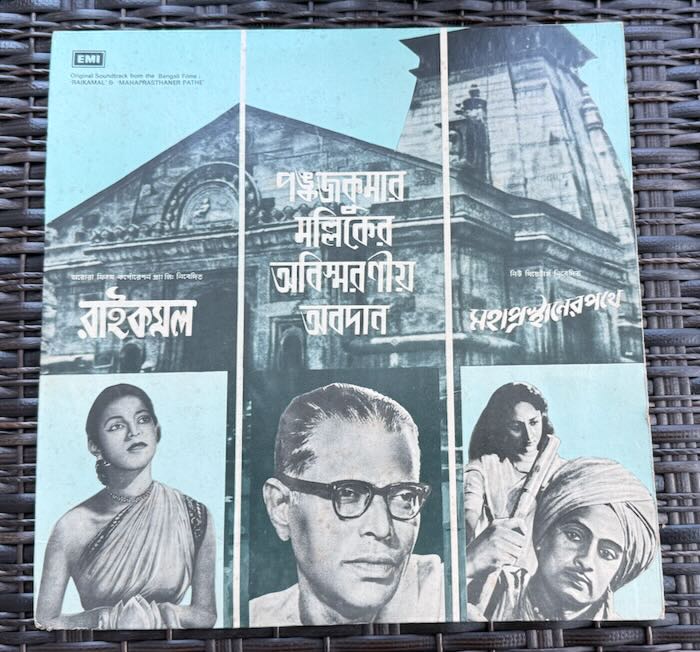
“Look for the LP of Mahaprastaner Pathe at Rhythm House at Colaba,” advised my cousin Bakin, on my trip to Bombay in 1989. “It contains all the songs of Yatrik.” I duly picked up my copy at Rhythm House, Bombay’s iconic music store, which sadly closed its doors a few years ago. A year earlier, my father’s uncle had graciously gifted us his old radiogram. A beautiful console that housed a German Nordmende radio and a British Garrard record player. We finally had the complete collection of songs from Yatrik, and on my return to Bangalore, I played it for my dad, one of the many times I would do so in the next couple of years before I left for the US.
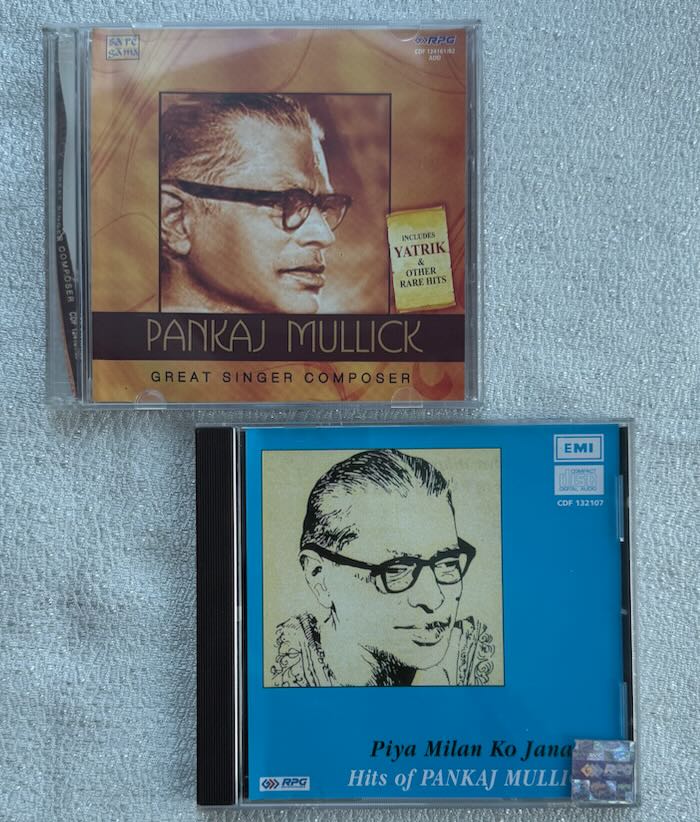
I picked up a dual CD set of Pankaj Mullick in the early 2000s; besides all his popular numbers, it contained the soundtrack of Yatrik. At around this time, I thought it would be cool if I could get my dad visuals from the movie. I searched the web and found that an institution in Germany listed a copy of the movie. I toyed with the idea of reaching out to them, but then gave it up as being impractical. By 2010, a few grainy prints of songs from Yatrik had been uploaded on YouTube. I recorded them on a VCD for my dad. We watched it once together, and I don’t think that the VCD has been played since.
That brings me to the present. A clear print of Yatrik has been uploaded to YouTube. Unfortunately, my dad’s hearing loss is so acute that he cannot enjoy the movie. Even if he could watch it, I doubt it would hold the same thrill it did when he first saw it. The milieu in which he watched the movie can never be recreated.
I decided to watch it recently, but gave up after the first twenty minutes. It is clearly a period piece; it must have been exciting to watch it in the 1950s. Just five years after India’s independence. In an era when distances were long, journeys were difficult, and access to information was severely limited, it must have been exciting to sit in a theatre and watch on screen the holy sites in the forbidding Himalayas. I can watch these sites and more in HD video now on YouTube. I also realise that for my dad, the songs were the main attraction; the movie probably did not hold much interest.
When I look back over my five decades, I see myself as a traveller on a journey I could scarcely have imagined. The changes I have witnessed have been nothing short of miraculous. From growing up as a young boy in India without the ability to listen to a song of my choosing, to owning cassettes, LPs, and CDs, and now watching songs on YouTube or streaming them on Spotify on demand, the transformation has been extraordinary. It is not just the ability to listen to songs. It is also the ability to peel back the layers behind them.

As I mentioned earlier, even if I was curious, there was no way for me to find out more about a song or a movie. The internet now informs me that Yatrik was directed by Kartick Chatterjee and released in 1952. It is a Hindi version of the Bengali original “Mahaprasthaner Pathe” based on a novel of the same name authored by Probodh Kumar Sanyal.
The little I watched of the movie included opening credits that began with a glorious shot of the Himalayas, accompanied by the Sanskrit hymn “Astayusrasthan Dishi Devatatma Himalayo Naam.” When I had listened to this song earlier, I could not even discern the lyrics, as they were in Sanskrit. Searching the web, I was excited to discover that these are the opening lines from Kalidasa’s poem “Kumarasambhavam.” Kalidasa, who lived around the 4th or 5th century CE, is considered India’s greatest poet and playwright. Listening to a song from 1952 evokes nostalgia; having it set to lyrics written 1500 years ago is priceless!

ChatGPT now translates the lyrics, and I can understand the song for the first time. The print on the Mahaprasthaner Pathe LP, which was once as impenetrable to me as Greek or Latin, can now be translated using Google Lens from the original Bengali. All of this happens from the comfort of my couch. Years ago, I would have had to seek out someone with knowledge of Bengali to translate the text for me. A classical Sanskrit scholar would have needed to listen to the song, identify it as coming from Kumarasambhavam, and then translate the lyrics. All of this was theoretically possible, but not practical in reality. If I have the time and the inclination, I can now read a 1941 translation of the poem on the Internet Archive. The print version of “Mahaprastaner Pathe” in Bengali is available on Amazon, where a reviewer waxes eloquently that it is the best travelogue written on the Himalayas.
It is remarkable that we now take all of this for granted. My daughter’s generation has never known a time of scarcity of information. It has never known a time of literally waiting decades to hear the entire soundtrack from an album, or a time of delayed gratification. We now live in a world of unlimited information, but I wonder how many people actually bother to find things out for themselves.

I’ve mentioned in the past that I am drawn to songs for their melody, and I sadly don’t pay attention to lyrics. The lyrics of “Tu Dhundtha hai Jisko” from Yatrik, though, are poignant to me
तू ढूँढता है जिसको
बस्ती में या के बन में
वह सांवरे सलोने रहता है
रहता है तेरे मन में
तू ढूंढता है
You search for the one
In the town or in the forest,
That dark, beautiful beloved
Lives quietly within your own heart.
Yet still you search for him.
I’m not religious, but I have a deep appreciation for music and tradition. The “dark, beautiful beloved” in the song refers to the Hindu god Krishna. My quest for the soundtrack of Yatrik should have ended in 1989 when I acquired the LP. In retrospect, I think I continued searching for videos and, later, for the movie because I wanted to gift my dad memories of his youth. In many ways, the thrill of the search was far more exciting than the acquisition itself.
The songs of Yatrik hold a special significance for me, as they carry memories of my childhood and a simpler time, moments when an unexpected song on the radio could make my day. They remind me of when my family was whole and of my youth, when time seemed to stretch endlessly. Each time I play those songs on my record player or stream them on Spotify, I suspect that a part of me occasionally yearns for that phase of my life. They say that time is like a river: you cannot step into the same river twice. True, but what is a traveller if he does not remember and sometimes yearn wistfully for the milestones of his journey?
ChatGPT’s translation of the lyrics of “Astayusrasthan Dishi”
In the northern direction, there is a divine spirit, the Himalaya, the king of mountains.
Stretching east to west like a treasury of waters, it stands as a measure of the Earth itself.
All the mountains, imagined together, with calves standing on their slopes, capable of giving milk,
Shine with jewels and great medicinal herbs, and they milk the Earth as commanded.
A single heap of clouds moves along, casting shade below;
The peaks, refreshed by the rain, receive the accomplished sages.
He, filling the muddy crevices of the valleys with the rising wind,
Desires to give even the kin of the Kinnaras (celestial musicians) access, as if granting them entry.
He, the friend of Mount Meru, mindful of the ancestors, standing for the welfare of the family,
Even venerable sages are to be respected, and he observes the proper regulations for them.