
The earliest lesson I can remember from any of my textbooks is one from my first-grade English textbook, “New Horizons.” It’s a tale of two frogs—one from Osaka and the other from Kyoto—who decide to explore the world. They journey toward each other’s cities and meet at the top of a mountain. As they raise themselves to peer over the other side, they end up seeing the same side of the mountain, as their eyes are set back. “There’s nothing different on the other side,” they mutter, and then make their way back home. There was an illustration accompanying the lesson, and a pagoda adorned the landscape of the frog from Kyoto. That was my first introduction to a pagoda.
My first real glimpse of a pagoda came earlier this month during a trip to Kyoto. My good friend Ashish had lived in Japan for a while and is an adopted son of the Land of the Rising Sun. Over the years, we had often discussed making a trip to Japan, and it finally came to fruition earlier this month. We spent time in both Tokyo and Kyoto. While Tokyo has its attractions, Kyoto especially charmed me. It has a slower pace of life and, from what I saw, is the cultural capital of Japan.
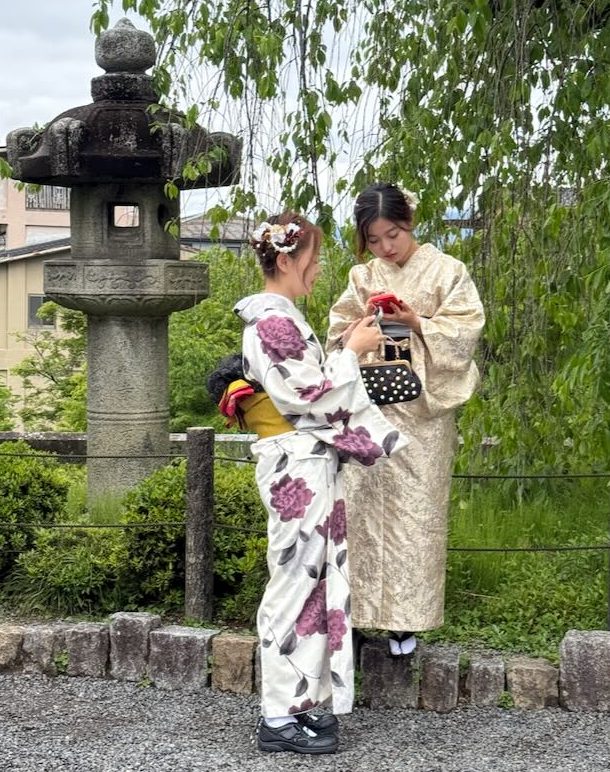
Our trip to Kyoto was sandwiched between our stay in Tokyo. During the first leg of our stay in Tokyo, I would whip out my phone to take pictures of the occasional house that had a roof with upturned eaves. Ashish chuckled and told me, “You haven’t seen anything yet. Wait till you get to Kyoto—there you’ll get your fill of those roofs.” And sure enough, these were ubiquitous in Kyoto.
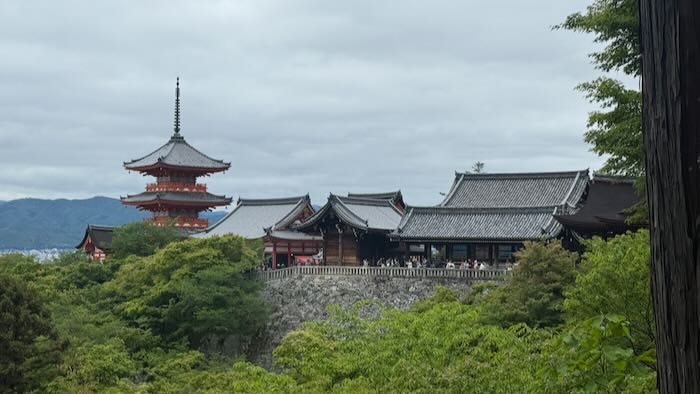
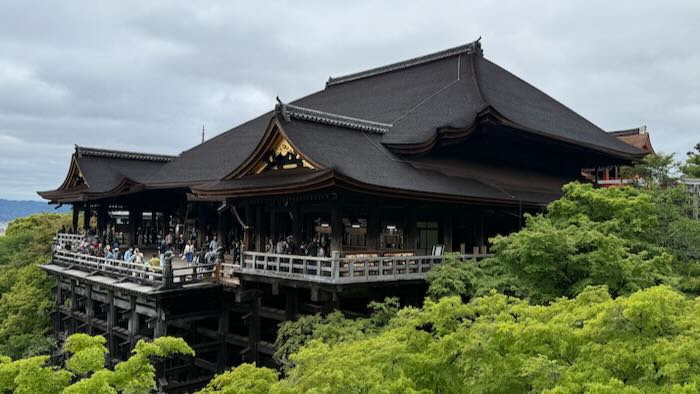
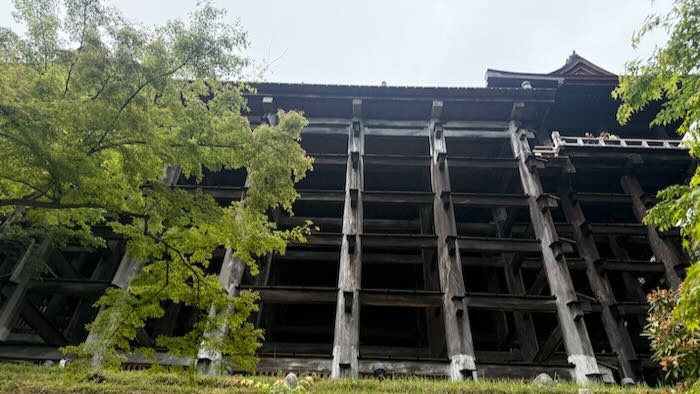
Kyoto boasts of hundreds of shrines and temples, and since we had only three days, we had to restrict ourselves to a dozen or so. These included a mix of Buddhist temples and Shinto shrines. It would have helped had I read up on them before visiting Kyoto. We noticed commonalities in their architecture, and only after returning home did I read more about them. Describing each shrine in detail would likely bore the reader, so I will instead rely on pictures and highlight a few distinctive architectural features.
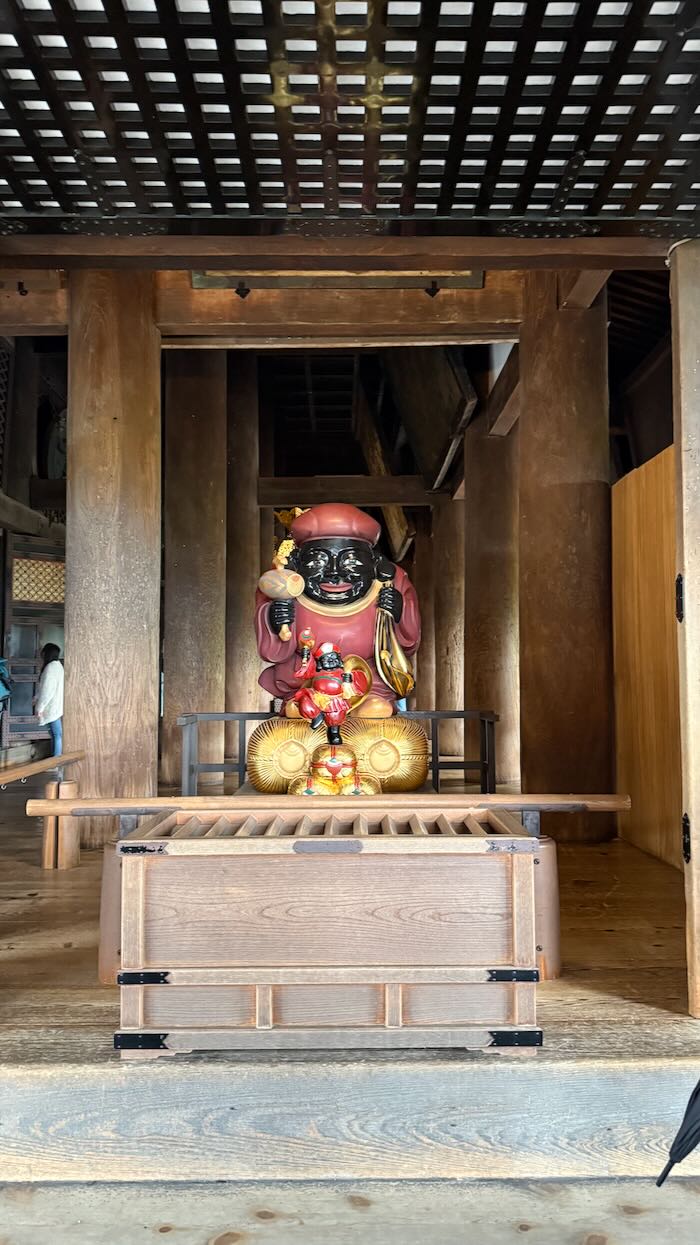
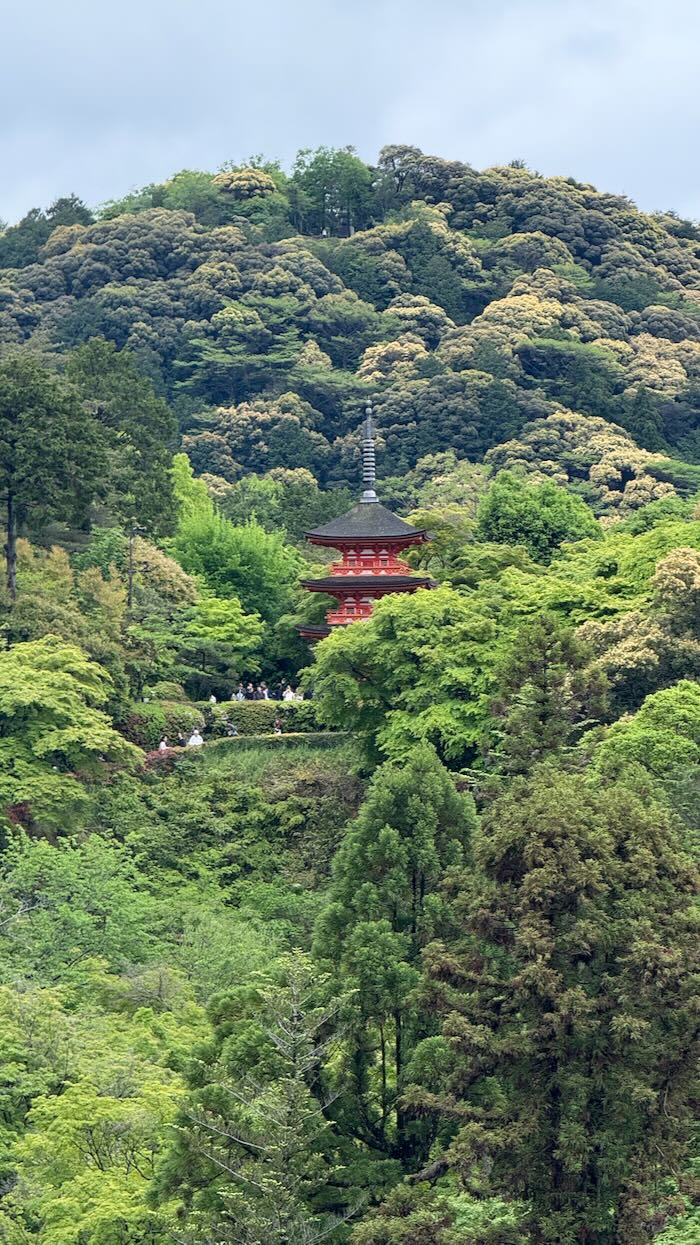
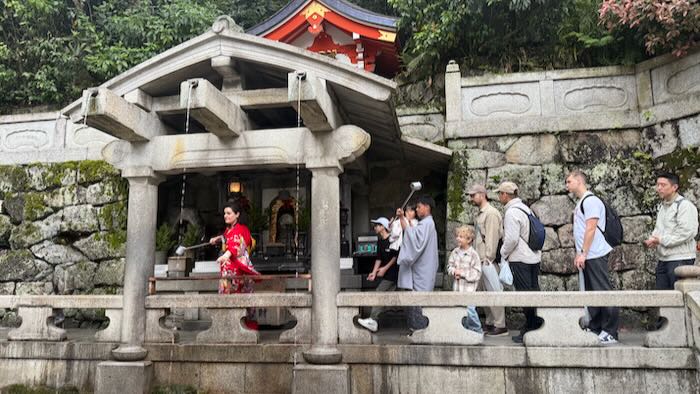
The first temple we visited was Kiyomizu-dera. I can’t think of a better one to begin with. Given that it was the tail end of Golden Week, it was crowded with both locals and tourists. Construction of the temple originally began in the eighth century, while most of the current buildings date back to the early seventeenth century. The name Kiyomizu (pure water) derives from a waterfall within the complex. While this is a Buddhist temple dedicated to Kannon—the Japanese form of the Bodhisattva Avalokiteshvara—there are also shrines to other deities. Kiyomizu-dera is a UNESCO World Heritage Site.

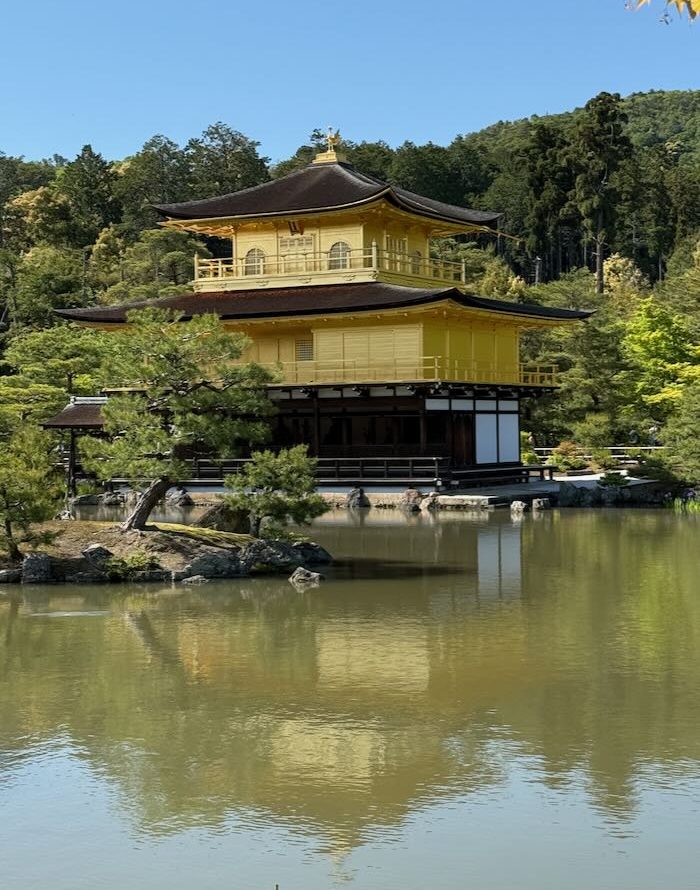
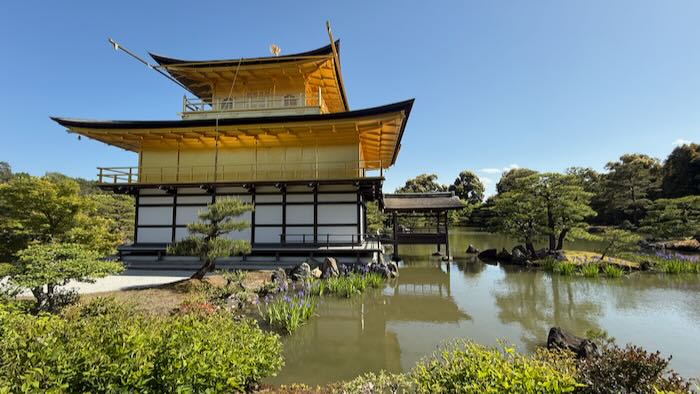
The Rokuon-ji (Deer Garden Temple) is more widely known as Kinkaku-ji, after the Golden Pavilion located within its temple complex. Ashish explained that “Kin” means gold in Japanese, and thus Kinkaku-ji translates to “Golden Pavilion Temple.” The main attraction is the three-story pavilion covered in gold leaf. Originally built in 1397, it was destroyed by fire in 1950 and rebuilt in 1955. This perhaps explains the phoenix that adorns the temple’s roof—a symbol of rebirth. The temple is surrounded by Kyōko-chi (Mirror Pond). I imagine the reflection would be a stunning sight on a still day. Visitors are not allowed inside the pavilion. Interestingly, the temple was originally the villa of a shogun and was converted into a temple after his death. Today, Kinkaku-ji is designated as a World Heritage Site.
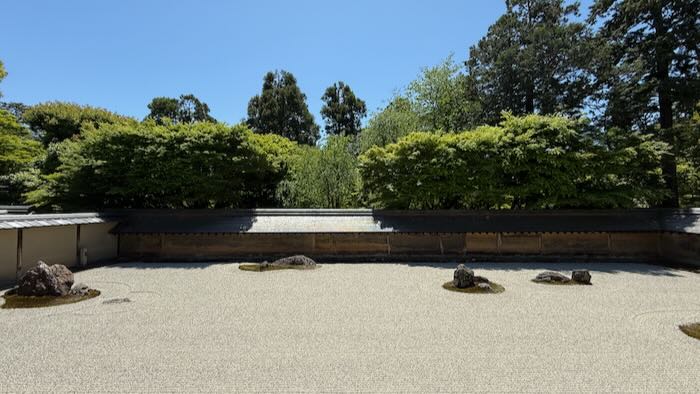
I first saw a Karesansui (dry landscape) Zen rock garden at the Morikami Museum in Boca Raton, Florida. However, the image etched in my mind is that of a Zen garden desktop wallpaper on my old iMac. I lost that image after a few OS upgrades. So when Ashish recommended visiting the Ryōan-ji temple, I searched for it online and was delighted to discover that it was likely the same Zen garden featured in that wallpaper.
Getting to Ryōan-ji involved an interesting ride on a single-carriage train. We then walked through sleepy neighborhoods with narrow streets. Our spirits lifted as we passed almost no tourists—we hoped for a less crowded experience at the Zen garden. But our hopes were dashed upon arrival. The garden was indeed beautiful and serene, save for a group of tourists chatting loudly, oblivious to the baleful glares of other visitors.
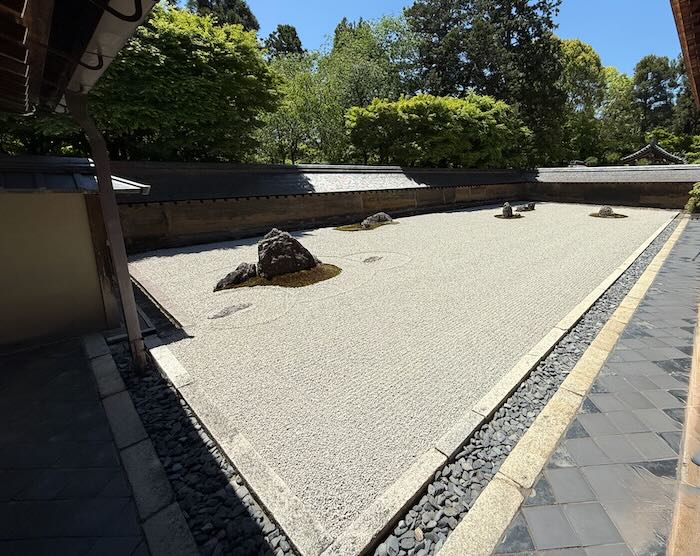
Ryōan-ji—“The Temple of the Peaceful Dragon”—was built in 1450 on the estate of an aristocratic family. It was destroyed by fire in 1473 and subsequently rebuilt at the end of the fifteenth century. Another fire destroyed the buildings in 1797, which were later rebuilt. The Zen garden, built around 1500, is rectangular and features 15 rocks arranged in five asymmetrical groups, surrounded by meticulously raked white gravel. The monks reportedly rake it daily, and the care they take is evident in the garden’s pristine appearance. The garden is enclosed on three sides by an earthen wall, constructed from clay boiled in oil. According to the brochure provided with the entry ticket, the patterns on the wall are the result of oil seeping out over time. The garden is traditionally attributed to a Zen monk named Tokuho Zenketsu.
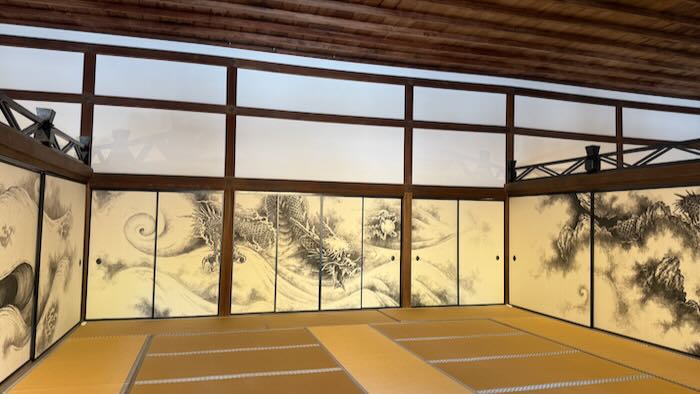
Adjoining the garden is the Hōjō (abbot’s residence). Its interior is adorned with paintings, including depictions of dragons, and the floors are covered with tatami straw mats. Visitors view the rock garden from the verandah of the Hōjō. I later read that the rocks are arranged so that, from any vantage point, only 14 are visible at a time—a deliberate design meant to illustrate the Zen principle that true understanding is always incomplete.

Indeed, the garden overshadows everything else at the site. After spending time there and picking up a couple of souvenirs, we wandered around the mirror pond, where we spotted a statue of the Buddha. I’m sure this garden, like many others in Kyoto, is a magnificent sight in autumn. Ryōan-ji temple and the Zen garden feature in the list of World Heritage Sites.
A visitor to Kyoto has the opportunity to explore 1,600 Buddhist temples and 400 Shinto shrines. I didn’t fully appreciate this fact when Ashish told me that one could spend a month in Kyoto and still see only a fraction of them. Once we arrived, we found that we could realistically visit perhaps four sites a day—if we took the time to truly experience each one.
Most people are drawn to the famous temples now popularized on social media. In this regard, I was fortunate to have a friend who had visited Kyoto several times and whose interests closely mirrored my own. Sanjūsangen-dō was one of Ashish-san’s recommendations.
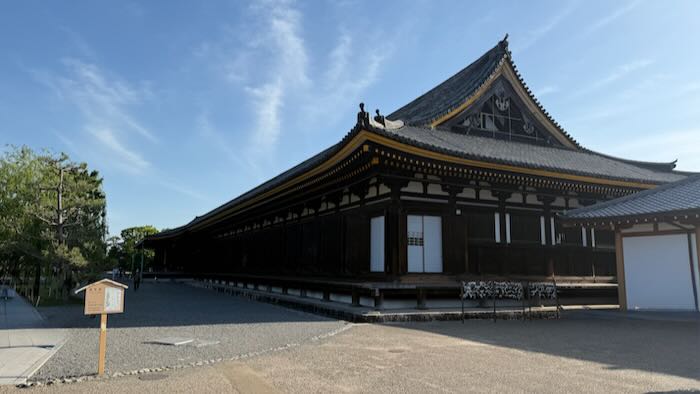
This temple is remarkable for its length, 120 meters (394 feet). Its official name is Rengeō-in (“Hall of the Lotus King”), but it is more commonly known as Sanjūsangen-dō, meaning “Hall with 33 Bays”—a reference to the 33 intervals between the building’s supporting columns. Photography is prohibited inside the temple, so I only have photos of the exterior and must rely on the brochure for images of the deities. The temple was originally constructed in 1164, and like many historic sites, was destroyed by fire and reconstructed in 1266.
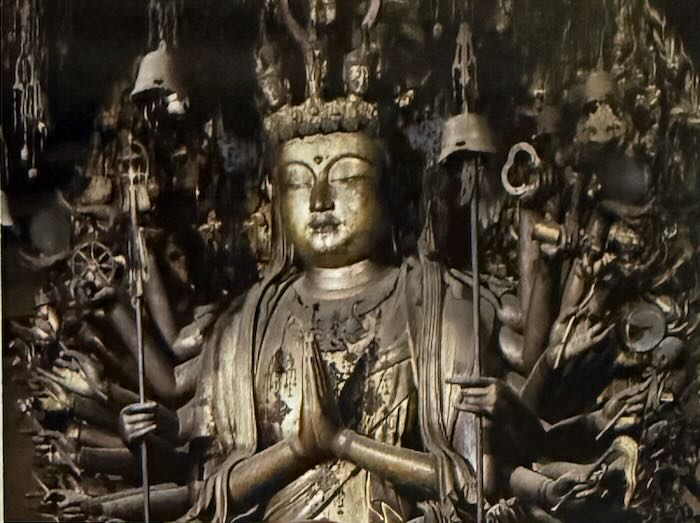
At the center of the temple is a seated statue of the thousand-armed Kannon. This image is flanked on either side by 500 standing Kannon statues, arranged in 10 rows and 50 columns. In front of them stand 28 guardian deities, and at each end of the hall are statues of the Wind and Thunder gods. All of these are intricately carved from Japanese cypress.
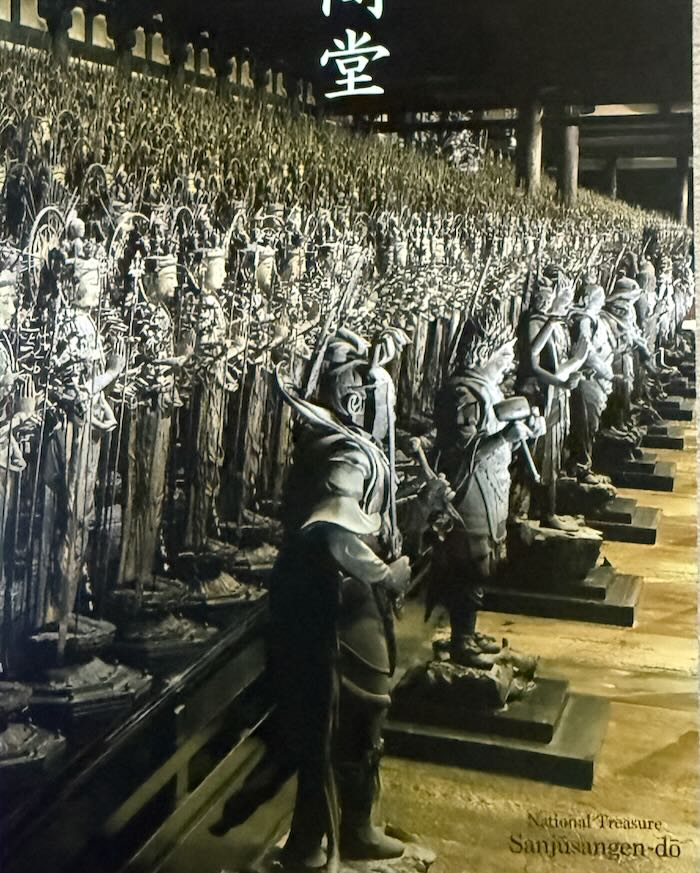
The guardian deities were of particular interest to us. Many are Hindu in origin, such as Narayana, Indra, Ganesha, Varuna, Garuda, and Nāgarāja. Buddhism arrived in Japan via China in the 6th century, nearly a thousand years after the death of the Buddha. This temple, built almost 1,500 years after his passing, reflects how Hindu gods were assimilated into Buddhist cosmology as guardian deities over time. We marveled not only at the fact that the temple itself is nearly a thousand years old, but that at the time of its construction, Buddhism had already been established for 1,500 years!
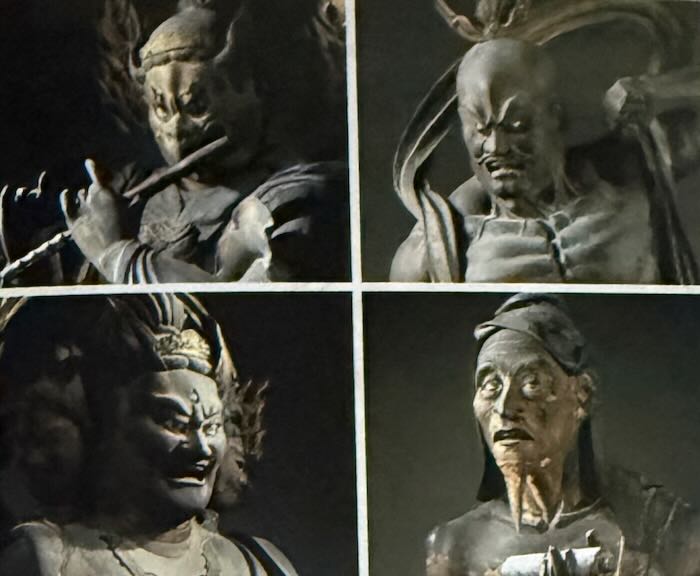
I would have been hard-pressed to identify any of these gods without the signs that provided their names and origins. The deities have been “Japanized” with symbolic references to their original forms. For example, the Ganesha figure has an elephant on its crown, and Nāgarāja (King of Snakes) wears a snake as a sash.
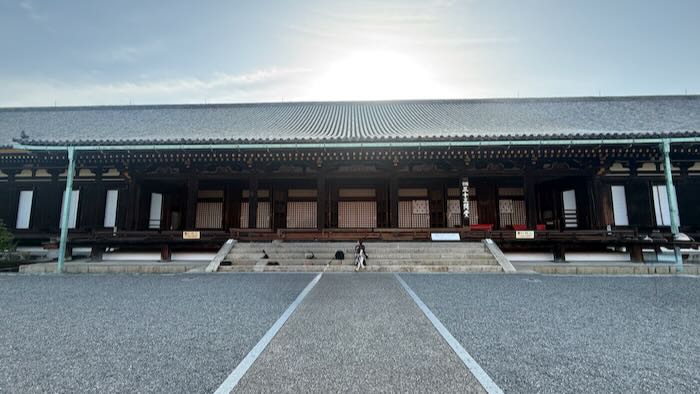
On the other side of the hall, exhibits chronicle the history of an archery tournament called Tōshiya, which was once held on the temple’s veranda. Original bows, scorecards, and paintings bring this tradition to life for visitors. As with many temples, there is also a Zen garden with a pond. Rhododendrons were in bloom at every garden we visited, adding bursts of color to the tranquil spaces.
Not all temples and shrines are as grand as those I’ve described. Just a stone’s throw from our hotel stood a small Shinto shrine called Shōtoku Suwa-jinja. A sign outside stated that it was originally constructed in 801 CE and is dedicated to Takeminakata-no-kami and Kotoshironushi-no-kami—both kami, or deities, in the Shinto tradition. Like many other shrines, it too had been destroyed by fire, with the current structure dating back to 1866.
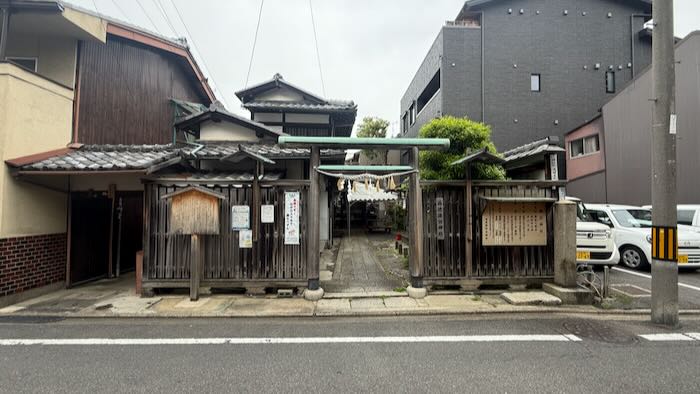
We stepped inside and passed a vertical stone placed on a pedestal. Nearby was a temizuya (water basin) made of stone, with a bamboo spout through which water flowed into the basin. A wooden ladle (hishaku) is used to pour water over one’s hands or rinse the mouth—a symbolic purification ritual. Besides traditional lanterns, we noticed zigzag paper streamers (shide), believed to ward off evil spirits, hanging from a string.
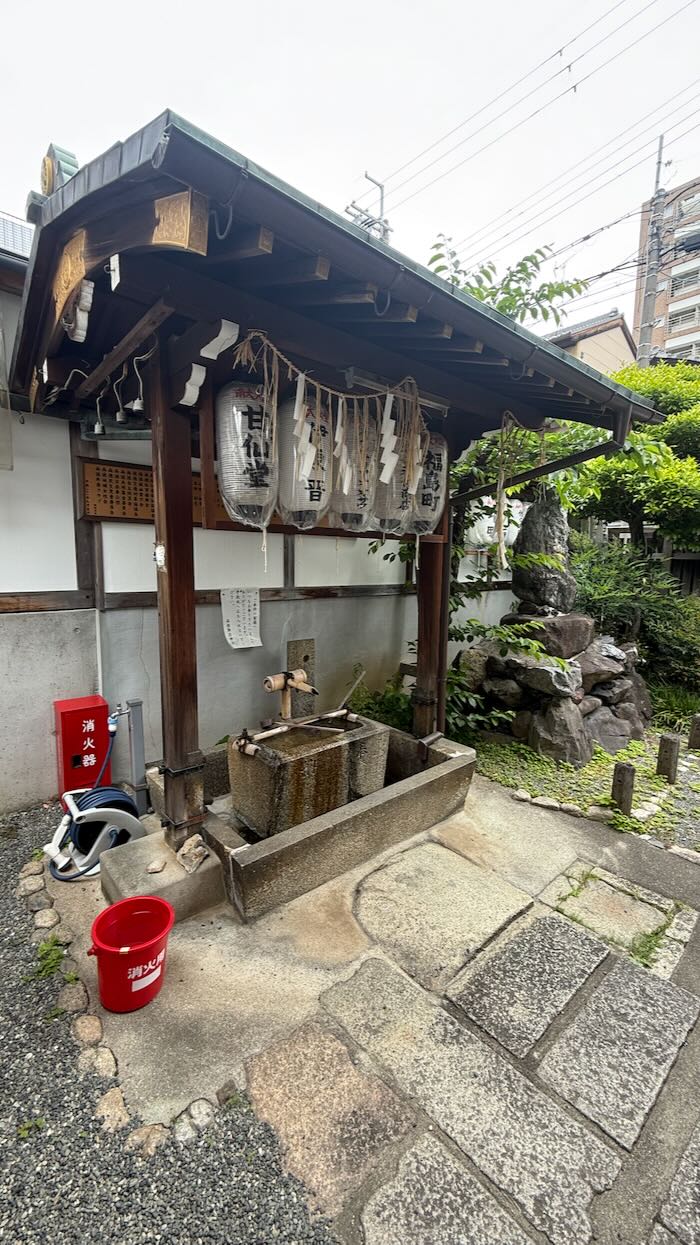
A neighborhood shrine, where the faithful can worship in peace and experience Zen in a big city. Indeed, I wonder if the natives of Kyoto visit any of the earlier temples that I have mentioned regularly. If my experience at Ryōan-ji was any indication, these are crowded with tourists and hardly afford any space for reflection or worship. But as a tourist, I was glad that I could visit these temples in the company of a wonderful friend.
Great captures nd lovely notes.
Japan is truly different from the mainland.
Visiting as a sailor, the cold icy winds on the Japanese coasts have never left my memory.
The ritual drums, the Buddhist and Shinto shrines are indeed classical and makes you wonder in awe; both at Japan and India.
While some similarities are inevitability obvious, perhaps we could learn a thing or two from the industrious and exacting people campaigns.
While strolling the village street, I was amazed to see some pedestrian sidewalk repair being executes by some senior citizens. Learnt later that they do the work themselves and have been high ranking officials from various professions.
While I continue to stay amazed with thr land of the rising Sun, the 13000 layers in the Samurai sword and unrelentingly unique life hacks that the country has contributed to, my heart saddens with some of the treatment that was meted out to fellow sailors, based on their origin country.
Have many lovely stories about Japan and the even remember travelling to Miura boiler manufacturing company. Was invited there because we pointed out a flaw in their control sysytems.
I carried with me a gift wrapped, something I called the best boiler in the world, much to their disdain and faces fell while maintaining a smiling front.
When u urged them to open the wrapping, it revealed an Indian bronze Sun complete with moustache. A gift from India to the land of the rising Sun.
Moods changed and they wouldn’t let me be thereafter.
Truly, understanding the people is the essense of travel.
“Traveling – it leaves you speechless, then turns you into a storyteller.” – Ibn Battuta
Thank you for sharing the lovely memories, Monty! You ought to write a book on your travels!