
In my last post, I wrote about my visit to a few temples in Kyoto with my friend Ashish, and now, I’m back with a few more to share!
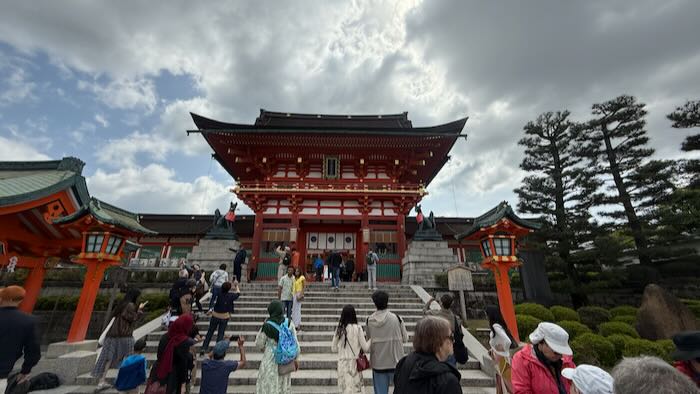
Fushimi Inari Taisha is among the most important Shinto shrines in Japan. The Taisha, or grand shrine, is located in Fushimi and is dedicated to Inari, a revered deity or spirit (kami). My friend Ashish and I headed to the shrine first thing in the morning of the second day of our trip to Kyoto, but we were not early enough—we found a large throng of visitors streaming through the two massive vermilion-painted Torii gates. These gates serve as traditional entrances to Shinto shrines.

We paused at the two-story Rōmon, the shrine’s main gate. A pair of Kitsune (foxes) flank the Rōmon, considered messengers of Inari. Passing through the Rōmon, one comes to the Honden, or main shrine, where the deities are housed. The public is not allowed inside.

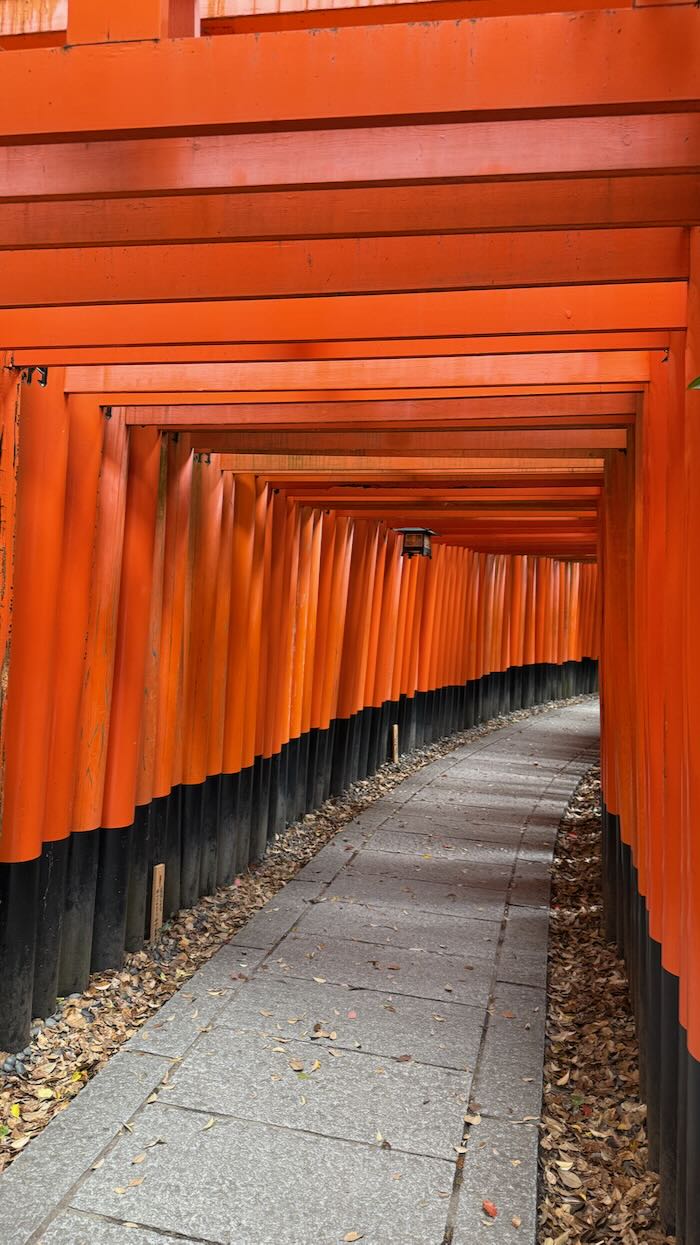
Going past the Honden, we reached what probably drives the shrine’s popularity on the internet—the One Thousand Torii. These are a series of vermilion gates donated by individuals and businesses. As of today, they number close to ten thousand. We walked through a few of them but had to keep stopping periodically to allow groups of people to pose for pictures. We managed to take a couple of photos when the coast was clear by waiting patiently on the sidelines.
We had a long day ahead, so we decided not to walk through all the gates to the shrine at the top of the mountain and made our way back. I read later that the Thousand Torii was featured in the movie “Memoirs of a Geisha,” which likely explains its popularity. Incidentally, Ashish highly recommends the book—I’m yet to read it.
As we were short on time, we took a cab to the next temple, Daigoji. This was a complete antithesis to Fushimi Inari Taisha. There were just a handful of tourists on the sprawling temple grounds. This should be on the itinerary of every Indian tourist. Daigo means “ghee” (clarified butter) and symbolizes the essence of Buddhist teachings. Every Indian has been told by their mother that ghee is the antidote to all of life’s problems. It’s only fitting, then, that we pay a visit to this temple.
At the ticket counter, Ashish asked the lady if she could give us directions to the Kinkakuji temple, the next stop on our itinerary. She did not speak English, and after a bit of a struggle, we thanked her, as we were holding up another tourist waiting to buy tickets.

Our first stop was the Sanbō-in, the former residence of the head priests. The walls of the rooms are painted with various motifs, including Mt. Fuji. We passed through the rooms, admiring the paintings, and found ourselves in the drawing room—Omote-Shoin. As we seated ourselves on the verandah, we were treated to the vision of a wondrous Zen garden. This was one of my favorite experiences of the trip. With just a couple of tourists nearby who maintained a respectful silence, we could sit down and listen to the wind rustling through the leaves and the steady flow of water from a waterfall at the far end of the garden as we took in the sights. The verdant garden contrasted beautifully with the Karesansui (dry landscape) Zen rock garden close to the verandah. I started taking pictures. After a few, I had to stop myself, put away the camera, and sit down to enjoy the peace and solitude. After a while, we reluctantly tore ourselves away and made our way out.


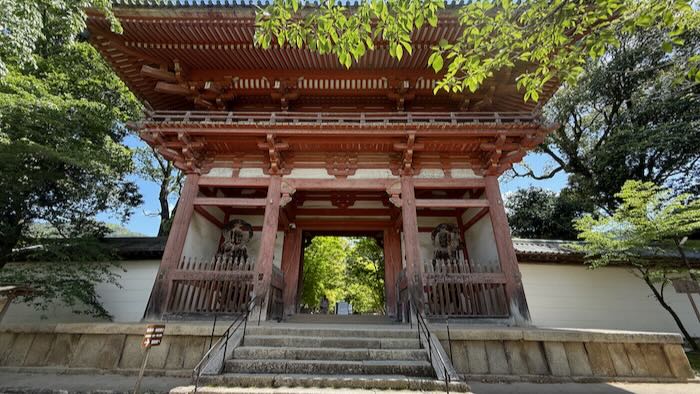
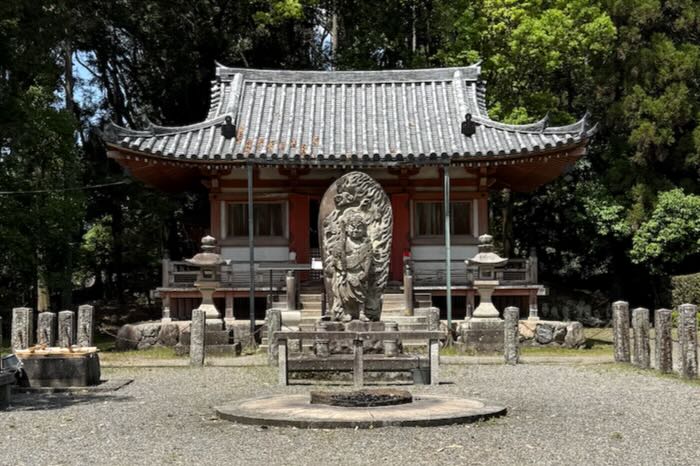
We then walked through the temple grounds, admiring the Main Gate and Main Hall. We spent a fair bit of time at the five-story pagoda. This pagoda, completed in 951 CE, is the oldest extant building in Kyoto. If you’ve read my last post, “Zen in Kyoto,” you’ll recall that several buildings were lost to fire over time and subsequently reconstructed. One of the causes was the Ōnin War in the fifteenth century, which devastated Kyoto, the imperial capital. This pagoda is one of the few structures that survived the war. Pagodas house relics but also serve as temples; in this respect, they could be considered the East Asian counterpart of the stupas found in India. We skipped the museum on site—a pity, as I’m sure it contains some interesting artifacts.


As we were leaving the temple complex, the lady at the ticket counter called out to us. She had gone online, figured out the directions, translated them from Japanese to English, written them down, and smiled as she handed us the paper. We were touched by her kindness. Ashish and I bowed deeply: “Arigatō gozaimasu!”
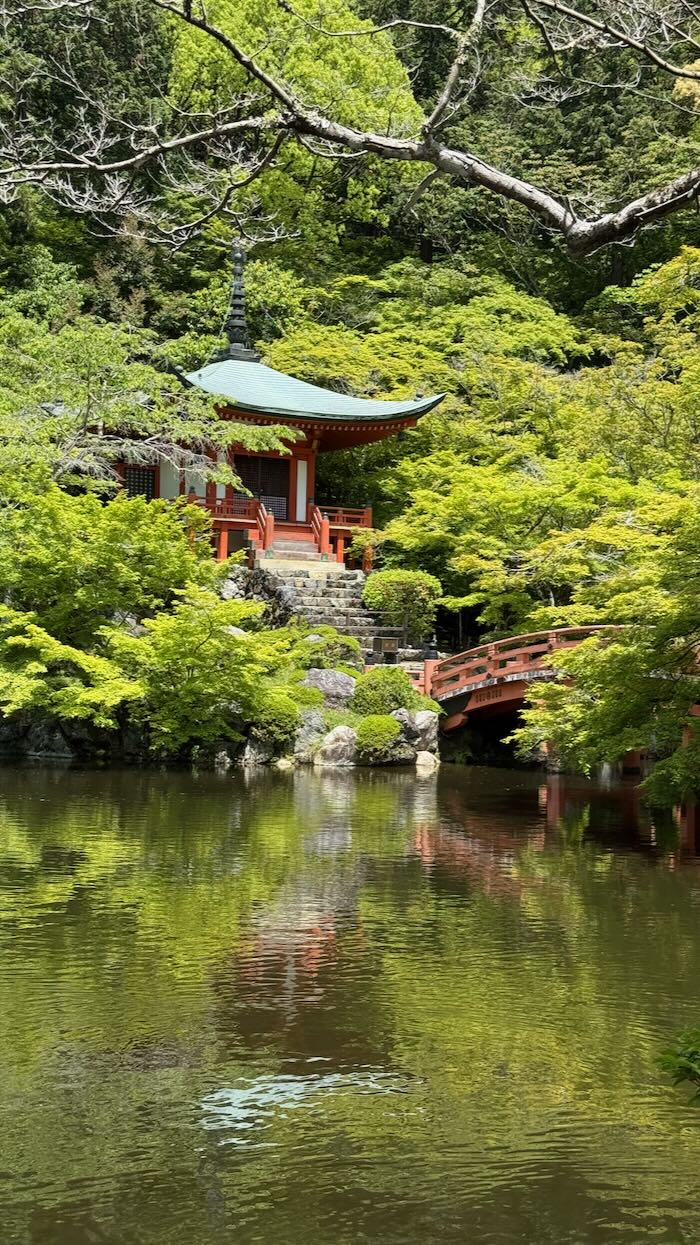
Daigoji may not be as flashy as Kinkakuji, as “instaworthy” as Fushimi Inari Taisha, or as picturesque as Kiyomizu-dera, but I liked it for the tranquility it exuded—and yes, for the kindness of the lady who took the time to help a couple of strangers with no expectation of reward.
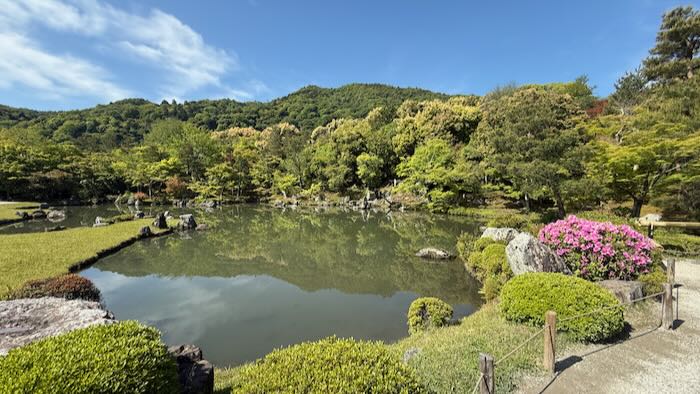
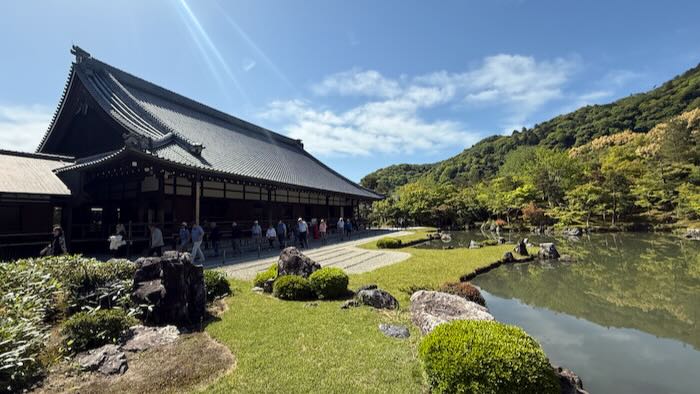
Tenryu-ji (Temple of the Heavenly Dragon) was not on our list of temples to visit. We passed by it while visiting the Arashiyama Bamboo Forest. It was established in 1339 and stands on the site of a 9th-century Zen temple that held the distinction of being the first Zen temple constructed in Japan. As with many other temples, this one too was destroyed by fires several times, and the current buildings were constructed in the 19th century. The Sōgenchi Garden, though, is among the oldest in Japan and dates back to the 14th century. We spent some time in the landscape garden and walked around the temple grounds before resuming our visit to the bamboo forest.

I’ve mentioned Ryōan-ji in my previous post. As we stepped out of the temple, we saw a sign pointing to Myōshin-ji, just 650 meters away. We figured it was close enough and walked leisurely through a residential area to the temple. We found a sprawling complex housing several temples, many of which were closed to the public. The grounds were originally donated by an emperor in the early 14th century. He had abdicated the throne to take monastic vows, and the palace grounds were used for constructing the temples. These temples, like others, suffered damage during the Ōnin War and were subsequently rebuilt. There were very few tourists here, and not much signage or information was available. So, after looking around for a while and taking a short break, we carried on.


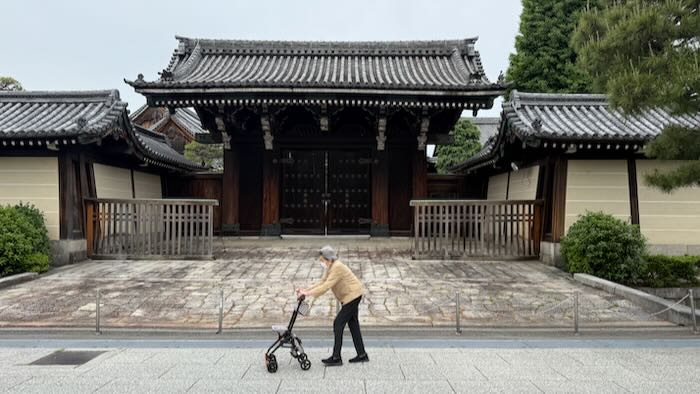
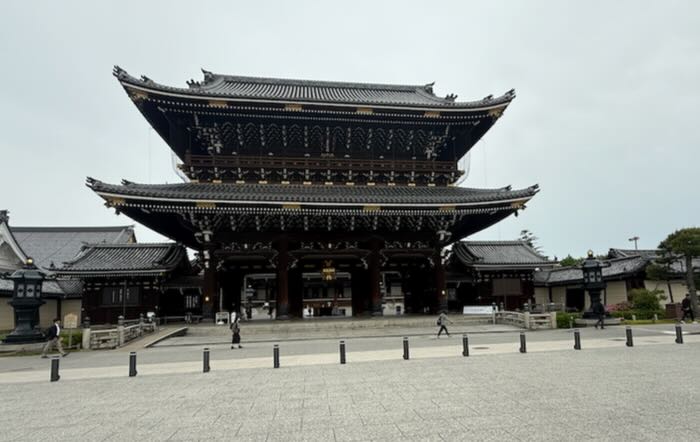
During our stay, we passed the Higashi Hongan-ji temple a couple of times each day as we made our way from our hotel to Kyoto Station and back. The Goei-dō Mon (Founder’s Hall Gate) looked impressive during the day and spectacular at night. We deferred our visit to this temple until the last morning of our stay in Kyoto. It turned out to be a good decision.
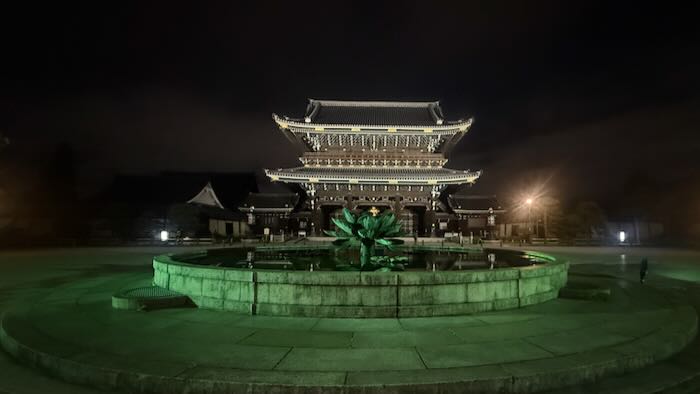

The temple was quiet in the morning with hardly any tourists. As Ashish and I walked through the imposing Founder’s Hall Gate, we were greeted by the even more impressive Goei-dō Hall (Founder’s Hall), considered one of the largest wooden structures in the world.
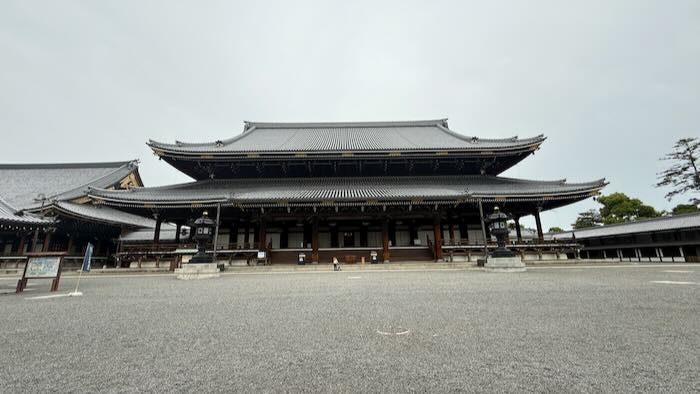
As we stood admiring the building, we noticed people dressed in priestly robes or some kind of uniform entering the hall. Ashish and I followed them and arrived just in time for what seemed to be the morning prayer—a melodious chanting that lasted about ten minutes. We found out later that these were temple employees. When the chanting ended, Ashish struck up a conversation with a priest seated nearby. We used Google Translate on our phones to communicate. He was pleased to hear that we were from India and asked about Buddhist sites in India. He said he had never visited India. As we were about to leave, he reached into a bag, pulled out a string of prayer beads, and handed them to us. He apologized that he only had one set. We were touched by his kindness and thanked him profusely.
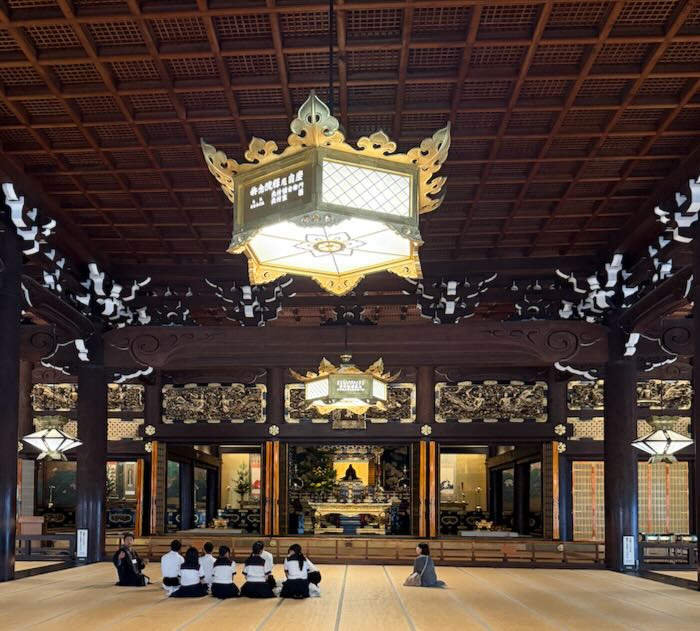
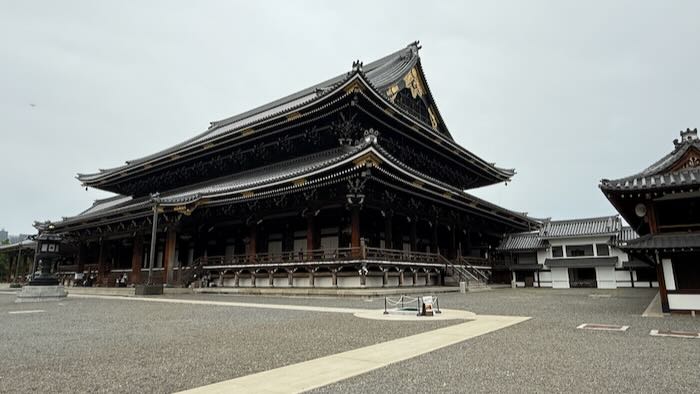

This was a fitting end to our temple tours in Kyoto. We had visited several temples, each impressive and beautiful in its own way. The buildings in Higashi Hongan-ji (Eastern Temple of the Original Vow) had also been destroyed in fires, with the current ones dating back to the late 19th century, relatively recent compared to the other temples we visited. The buildings in Higashi Honganji are imposing and majestic, yet the morning prayer and our meeting with the priest made the visit feel personal and meaningful.


This concludes my post on the temples of Kyoto. My visit to Kyoto was interesting in more ways than one. I was naturally drawn to the architecture and beauty of the temples. It was also fascinating to see the evolution of the worship of the Buddha, from the austere rock-cut caves of Kanheri in India to the magnificent wooden temples of Kyoto. Buddhism made its advent in Japan in the sixth century CE, a full thousand years after the death of the Buddha. By this time, Buddhism had reached its zenith in India and was starting to decline. The teachings had passed through China to Japan over a thousand years. It’s fascinating to think of a time when ideas had to travel physically over mountains, deserts, rivers, and oceans, carried by pilgrims, monks, and traders. Today, they spread like wildfire over the internet. Sadly, so do the bad ones! I suspect, though, that the old ideas will endure and stand the test of time.