
Comics were an integral part of my life growing up. I read them all without discrimination. However, there was a clear hierarchy within the world of comics. The Amar Chitra Katha series (Eternal Stories in Pictures) was probably the most ubiquitous, as it was printed in India. It was also the kind you were most likely to receive as a gift from elders in the family, since it focused on stories and characters from Indian mythology and history.
Mandrake and Phantom comics, published by Indrajal, were also popular and widely available. American-printed comics such as Archie, Richie Rich, Dennis the Menace, Sad Sack, and Casper formed the next rung. These were more expensive and felt like a treat whenever we managed to get our hands on them.
The Commando comics series, printed in Britain, was equally popular. At the top of the hierarchy for me were the Asterix and Obelix series and the Tintins. These were perhaps the most expensive, and the fact that each series comprised only a limited number of titles made them a rarity. Asterix and Obelix deserve a separate write-up of their own.
The Tintin series chronicles the adventures of a boy reporter and his faithful dog, Snowy. A boy reporter indeed—he doesn’t even have facial hair—yet he gets tangled up in fantastic adventures with some truly nasty characters, always managing to come out on top. Planes, trains, automobiles, motorcycles, ships, submarines, lunar rockets—it was a heady cocktail no young boy could resist!

My first Tintin was The Crab with the Golden Claws. My friend and neighbor Deepu had received it as a birthday gift, and I still remember the sense of wonder I felt when I first read it. Published by Methuen, it was larger than any of the other comics I had read until then. The quality of the paper and print was far superior to my usual fare of Amar Chitra Katha and Indrajal comics. The pages were printed on matte paper with sewn or cloth binding. They were available in hardcovers as well.
The story begins somewhere in Europe (I assumed incorrectly that it was London), where Tintin learns of a sailor’s murder from a pair of detectives named Thomson and Thompson. His investigation leads to his kidnapping, and he soon finds himself in the Sahara Desert, with an alcoholic sailor named Captain Haddock as his unexpected ally. Despite Captain Haddock’s drunken antics that frequently put them in danger, Tintin manages to solve the murder and, in the process, brings a gang of opium smugglers to justice.

The back cover of each comic featured miniature images of all the books in the series. I read them over the years as I came across them.
There were two main sources for Tintin comics. One was the local library near our rented house in Kumara Park. The other was a library in Kings Circle, Bombay. The former didn’t have the entire series—the comics were very popular, and we read the few that were sporadically available. The library in Kings Circle was a wooden shack, but it was a veritable treasure trove of Tintins, Asterix, Hardy Boys, Three Investigators, and more. These were staple reading when I visited my grandparents‘ house for summer vacations during my childhood.
I must admit, though, that I probably read Tintins only until around seventh grade, after which my taste in fiction and action was gradually drawn more to novels—Alistair MacLean, Sidney Sheldon, Jeffrey Archer, Irving Wallace, James Hadley Chase, and the like.
At the time, I assumed the Tintin comics were fairly contemporary. It had only been a decade since the moon landing, and I believed that Destination Moon and Explorers on the Moon had been written afterward. While we enjoyed reading the comics, there was hardly any information available about the author, Hergé, or the series itself.
What little I learned was pieced together from the occasional quiz I attended. From one, I discovered that Hergé was the pen name of Georges Remi, and that he was Belgian. From another, I learned that Tintin was based on a character named Totor.
Those were the pre-Internet days—information came almost entirely through print media, and we were limited by whatever happened to be available at the time.

There was an extended period, from 1981 onward, when I hardly read Tintins. Then, sometime in 1997, my brother gifted me a few, and I went on to purchase the rest of the series. They now occupy a place of pride on my bookshelf, alongside the Asterix and Obelix series. These are published by Mammoth now; the Methuen versions are now collectibles. especially prized are the hardcovers and first editions.
A couple of years ago, during one of our weekly conversations, my cousin Bakin recommended Michael Farr’s Tintin: The Complete Companion. I tucked that nugget of information away for future reference. The book is out of print, and used copies sell for well above the original price on Amazon.
Recently, on a whim, I searched my local library’s catalog and was delighted to find not only that book, but also Farr’s The Adventures of Hergé: Creator of Tintin available in the library system.
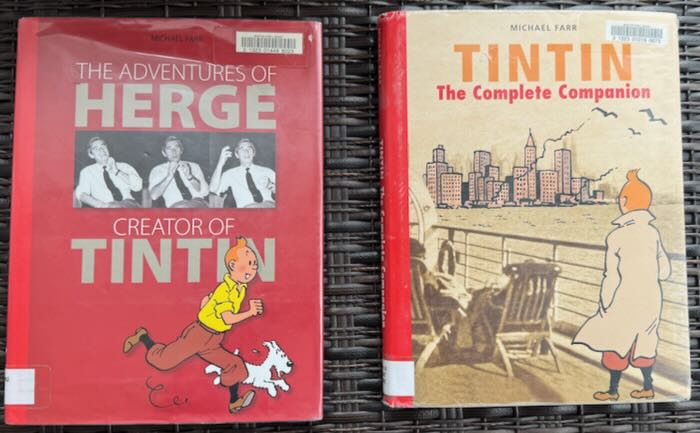
While the latter is a biography of Hergé and interesting in its own right, the former is an absolute must-read for any Tintin fan. In Tintin: The Complete Companion, Michael Farr provides the story behind the story for each of the Tintin books.
Over the past four months, I’ve found myself reading a chapter of Farr’s book, then revisiting the corresponding Tintin comic. The experience has left me with a deep appreciation for Hergé’s creativity and craft.
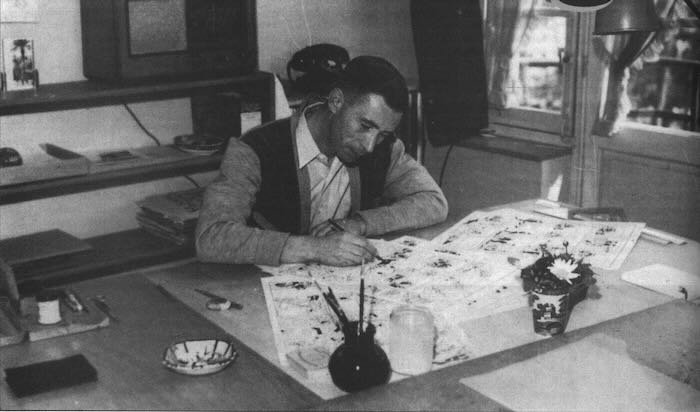
Georges Remi was born in a suburb of Brussels in 1907. He began drawing at a young age, and seeing his interest, his parents enrolled him in an art class. However, he attended only one session, finding the exercise of copying a Corinthian capital tedious and uninspiring. His real passion was scouting, which led him to contribute to the magazine Le Boy-Scout Belge at the age of 16. It was there that he created a character named Totor and adopted his pen name, Hergé, derived from the French pronunciation of his reversed initials, “RG.”
Hergé aspired to be a journalist but began his career in the subscriptions department of the Belgian newspaper Le Vingtième Siècle (The Twentieth Century). Father Norbert Wallez, a Catholic priest and the paper’s editorial director, recognized his talent and promoted him to illustrator. This was a time when photographs were scarce, which gave Hergé ample opportunity to illustrate various sections of the paper. He was later entrusted with the paper’s Thursday children’s supplement, Le Petit Vingtième (The Little Twentieth), which he would eventually transform into the platform for his most famous creation.
It was at Le Petit Vingtième that Tintin was born in 1929. Tintin in the Land of the Soviets was serialized as a black-and-white comic strip. Reflecting the times, it featured strong anti-communist themes. Tintin, as a reporter, exposes rigged elections, fake factories built to impress visitors, repression of the population, and the excesses of the secret police.
Following the success of this initial comic, Tintin’s next adventure took him to the Congo. Tintin in the Congo was written at the urging of Father Wallez, editor of Le Petit Vingtième, who wanted to promote the Belgian colony to his young readers. In this story, Tintin bags a lot of big game (which reminded me of The Swiss Family Robinson), encounters naïve natives, and crosses paths with a diamond smuggler working for Al Capone. Both stories were published in serialized form.
I hadn’t heard of these two editions while growing up in India and was surprised to read about them in Michael Farr’s book. The English versions of these books were published by Methuen in 1989 and 1991—long after my Tintin reading days in India. By then, colonial attitudes had shifted, and the English edition of Tintin in the Congo toned down the graphic violence related to hunting animals and was published with a disclaimer.
I remember the buzz at my school when news spread of the release of a new Tintin: Tintin in America! When I finally got to read it, a couple of years after its release, it felt a bit anachronistic. Set in 1930s America, it featured Indians, cowboys, and Al Capone. What I didn’t realize then was that this story was originally serialized in 1931–32, and its first English edition was printed by Methuen in 1978—well after the other English Tintin editions. What I had assumed was the latest book in the series was the earliest English edition at that time!

Tintin and Snowy in Tintin in the Land of the Soviets
Thomson and Thompson in Tintin in the Congo notice Hergé in a tan jacket and gray slacks
Rastopopoulos in Cigars of the Pharaoh
Bianca Castafiore in King Ottokar’s Sceptre
Captain Haddock in The Crab with the Golden Claws
Professor Calculus in Red Rackham’s Treasure
When I read the series as a kid, I enjoyed the adventures and the characters, but never paused to wonder if they were based on real people. Even if I had, there was no way to find out. I was intrigued to read that Tintin was inspired by Hergé’s younger brother, Paul, who had a round face when he was young. Tintin’s characteristic quiff first appeared while he was accelerating a Mercedes-Benz in Tintin in the Land of the Soviets and remained a defining feature of his look.
The bumbling detectives Thomson and Thompson were based on Hergé’s father, Alexis, and uncle, Leon—identical twins known for their Sunday walks wearing bowler hats, best suits, and carrying canes. Tintin’s father was an outfitter, so characters in the Tintin series are immaculately attired.

Tintin’s fox terrier, Snowy, is called “Milou” in the original French version of the comics. Milou was the nickname of Hergé’s first girlfriend, Marie-Louise Van Cutsem. Her father made her break off the relationship with Hergé, believing he was beneath their social station.
The absent-minded Professor Calculus was inspired by the Swiss physicist Auguste Piccard. Apart from their inventive genius, their personalities were like chalk and cheese. Surprisingly, Captain Haddock does not seem to have a real-life counterpart. And last but not least, the formidable opera singer Bianca Castafiore was based on Hergé’s maternal aunt Ninie, who reportedly sang very badly. Hergé disliked opera, and his feelings come through in the tortured expressions of the hapless audiences at Castafiore’s concerts!

Michael Farr paints the portrait of a meticulous artist who collected photographs, postcards, articles, and magazines, drawing inspiration from them for his work. The planes, ships, and cars in the Tintin series were often based on actual models. The cover of The Broken Ear, for example, was inspired by a photograph of a dead tree lying across a river. The Arumbaya fetish in the same story was modeled after a pre-Columbian artifact housed in a museum in Brussels.
The sheer cliffs of The Black Island were based on a photograph of Brittany’s rocky coastline. The sceptre in King Ottokar’s Sceptre was inspired by a photograph of a Polish sceptre. And the Château de Cheverny in the Loire Valley in France served as the inspiration for Marlinspike Hall.
Hergé based his plots loosely on real events. However, his interest in dreams, mysticism, and Eastern philosophies and religions often found their way into his stories. He kept in touch with a clairvoyant, and his fascination with fortune-telling translated into characters such as the Gypsy fortune teller in The Castafiore Emerald and Madame Yamilah in The Seven Crystal Balls. Dreams and nightmares also feature prominently throughout his books.
Hergé also drew inspiration from contemporary cinema. Farr notes the espionage theme and the pursuit of Tintin in The Black Island (1937) has parallels to Alfred Hitchcock’s film The Thirty Nine Steps (1935). Ranko, the brutish-looking but soft-hearted gorilla, was probably inspired by 1933’s King Kong.
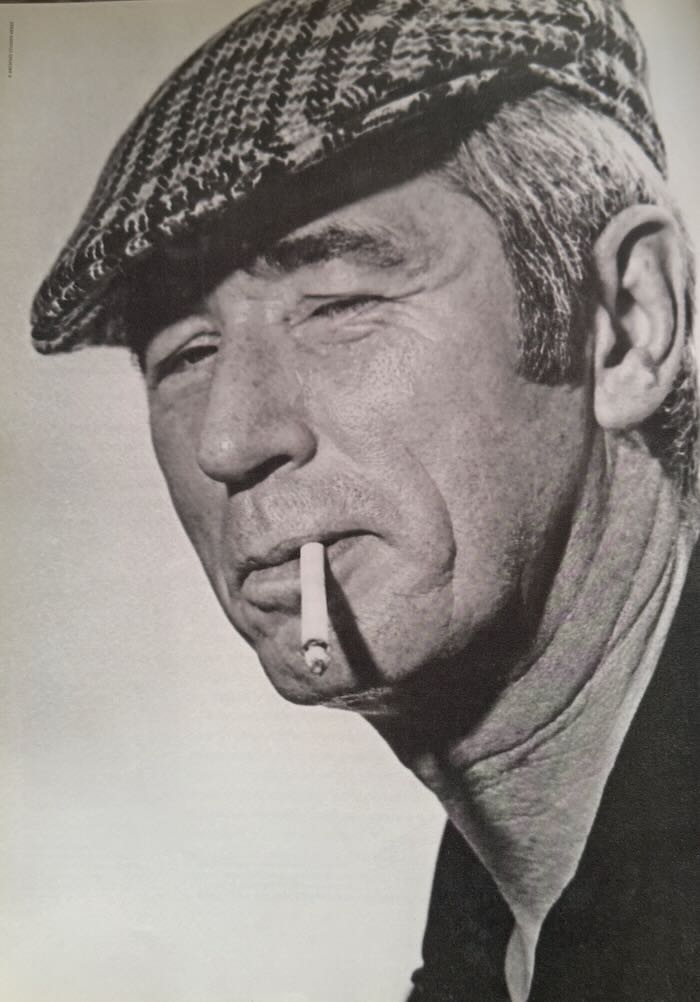
Farr also traces the resemblance of various characters to well-known public figures of Hergé’s time. Although Hergé never traveled to the exotic locales where Tintin’s adventures unfold, his careful attention to detail and his artistic reproduction of reference images give his stories an unmistakable authenticity.
During Germany’s invasion of Belgium in World War II, Le Petit Vingtième—along with its parent newspaper—was shut down. Hergé, suddenly out of work, chose to remain in Brussels rather than flee to Britain. He brought Tintin to Le Soir, one of the few newspapers still in circulation under Nazi control. To his discomfort, Tintin was soon published alongside Nazi propaganda, a juxtaposition that would later cast a long shadow over his reputation.
After the war, Hergé was branded a Nazi collaborator and found himself without a job and arrested four times, though he was released, spending just one night in jail—an experience that left scars which never fully healed, as evident in his later interviews with Numa Sadoul in 1971-72. Farr notes that Tintin, in more than one adventure, actively opposes fascist regimes and that the accusations of Nazi collaboration were largely unfounded.
Redemption came through the launch of Tintin Magazine by Raymond Leblanc, a hero of the Belgian Resistance. Hergé resumed his work there before eventually founding his independent studio and taking on commission work for advertising, typography, and book design. When Tintin’s popularity soared, he hired a team but continued to be the principal author and artist. He worked tirelessly, with the pressure of producing weekly strips taking an enormous toll. At one point, he took an extended break to go camping and hiking before returning to work refreshed. Each Tintin was originally written in the episodic comic strip form and later printed as a book. The first three books were printed by Le Vingtième Siècle, after which Hergé signed an exclusive contract with Casterman.

A keen admirer of art, Hergé accumulated a personal collection of paintings over his lifetime. When he passed away in 1983, he was working on his 24th Tintin story, Tintin and Alph-Art, which remained unfinished.
In all, he created 23 complete Tintin adventures over a career that spanned 54 years. The Shooting Star, published in 1942, was the first to appear in color. The earlier books were subsequently reprinted in color, with the notable exception of Tintin in the Land of the Soviets, which remained in its original black-and-white form. Hergé, who had nursed ambitions of becoming a journalist, lived vicariously through Tintin as a foreign journalist. Ironically, in all of his adventures, Tintin submits a press report just once, in Tintin in the Land of the Soviets! Even though he is referred to as a boy reporter in future adventures, he plays the role of a detective. Hergé did insert himself and his colleagues and friends into the adventures through cameo appearances. He is a guest at the Royal reception in King Ottokar’s Sceptre, and a journalist in Tintin in the Congo.

When Methuen began publishing the Tintin comics in English in the late 1950s, they commissioned Michael Turner and Leslie Lonsdale-Cooper to translate the books from French. The duo collaborated closely with Hergé and did a fantastic job capturing the tone and wit of the originals, famously giving Captain Haddock his colorful and unforgettable vocabulary. A great quiz question would be to explain one of Haddock’s signature expletives: “Bashi-bazouks!” These were irregulars in the Ottoman army, known for living off plunder and having a reputation as undisciplined bandits. As I mentioned earlier, I had assumed Tintin was based in London. The English names of the characters, the setting of The Black Island in Scotland, and Marlinspike Hall all gave it an English feel. I only realized much later that Tintin was originally printed in French and was modified to appeal to an English audience.

I’m a trivia buff, and Michael Farr’s book is a treasure trove for any Tintin fan. For instance, the original French edition of The Black Island featured Tintin riding a railcar emblazoned with “Johnnie Walker Whisky.” Methuen balked at the branding, and the English version swapped it for “Loch Lomond Whisky,” which went on to become Captain Haddock’s drink of choice in later adventures. Captain Haddock drinks an unnamed brand of Whisky in the French versions as well as in The Crab with the Golden Claws. Ironically, the current Loch Lomond distillery was founded only in 1964, and The Black Island was reissued in 1966!

Destination Moon and Explorers on the Moon were ahead of their time—published fifteen years before Apollo 11 and even two years before Sputnik. The rocket designed by Professor Calculus was powered by a nuclear motor—testament to Hergé’s imaginative foresight.
During World War II, The Crab with the Golden Claws was serialized amid paper shortages, resulting in shorter strips. When it came time to publish it as a book, Hergé had to add full-page illustrations just to meet the standard 62-page format of Tintin books. Those were the full-page illustrations that caught my eye when I read my first Tintin!
Chang, the Chinese boy in The Blue Lotus, was based on Chang Chong-chen, a Chinese sculptor and student in Brussels who became one of Hergé’s closest friends. His influence is apparent in Hergé’s portrayal of the Chinese in The Blue Lotus. It was notably more sympathetic and free from the crude stereotypes that were common in Western media at the time.
I certainly enjoyed the experience of rereading the Tintin series over the last few months. I must confess, though, that it lacked the sense of anticipation and excitement that greeted each Tintin book during my childhood. Scarcity, after all, has a way of heightening the enjoyment of things. I still remember the joy of discovering a couple of Tintin comics in the quaint library at Karkala in 1989 while I was visiting my friend and roommate, Guru. There was a special thrill in stumbling upon and reading an unexpected Tintin in the cool confines of that high-ceilinged library on a hot summer afternoon, silent except for the drone of a ceiling fan.
The shared experience of reading a Tintin amongst the company of friends and cousins also added another delightful dimension. We laughed at the antics and malapropisms of Thomson and Thompson. We swore at each other using Captain Haddock’s choicest expletives. We imagined ourselves as characters in our own Tintin-style adventures. We even tried, somewhat unsuccessfully, to draw our comic strips sporting a stick-like Tintin and a sausage-like Snowy.

Now that I think of it, Tintin is, in many ways, a clean-cut blend of James Bond and Indiana Jones. He saves nations, busts spy rings and drug cartels, pilots planes and submarines, walks on the moon, and explores the ocean floor. He treks through the jungles of India and Peru, deciphers cryptic instructions and ancient maps to uncover hidden treasure, and tangles with tribes in far-flung, exotic lands. Professor Calculus is the original Q; Thomson and Thompson are the epitome of inept police forces. If Auric Goldfinger tries to kill James Bond with an industrial laser in Goldfinger, the Incas try to incinerate Tintin with a giant magnifying glass in Prisoners of the Sun. Blofeld is the malignant villain who features in multiple Bond movies. Rastopopoulos, with his bulging nose, features in six Tintin comics and was the villain in the unfinished Tintin and Alph Art. Indiana Jones was an explorer-archaeologist who pursued mystical objects in ancient ruins and lost civilizations. He evaded booby traps and tangled with murderous villains. So did Tintin — the only difference is that he was an explorer-reporter! Bond was suave and cynical, Jones, rugged and irreverent, Tintin, clean-cut, smart, and polite! Hergé was certainly ahead of his time!
Billions of Blue Blistering Barnacles! The same heady cocktail of adventure, gadgets, exploding objects, and treacherous villains that was irresistible to a young boy in Bangalore remains just as irresistible to this older boy with a young heart. And he’d be delighted to share a wee dram of Loch Lomond with Captain Haddock! “Slàinte!” Or should that be “Santé !”
All images from the various Tintin comics are copyright Casterman
Oh man this takes me back. Thanks for this. Going to pick up Michael Farr’s books soon.
The library you mention in Kumara Park, was it Feel Free? If so, it’s the same one my sisters and I would frequent, since we lived in Kumara Park too.
It was that library, and Thyagu’s Library in Coimbatore (where my grandparents lived) that supplied all the fodder in my early years. I miss libraries now.
Hi Vivek, I don’t remember the name, it was on Serpentine Road, towards the Gutahalli side. It was in the garage of someone’s house. Happy reading!
Your blog brings back so many beautiful memories . Tintin , Obleix , Dogmatix , Snowy , Calculus , Wendy ,.Richie Rich , Veronica , Betty , Jughead , Dennis, Casper – i could go on and on. Recently I lost a whole set of Tintin and asterix comics. I couldnt be sadder .
Your blogs are a joy to read.
Thank you for your kind words, Sheela! You might enjoy my earlier writeup on Phantom if you haven’t read it.
https://www.memoirsofanaveragejoe.com/2018/01/24/the-phantom/