
An Englishman living in the United States in the late nineteenth century wrote stories about an Indian boy that continue to captivate children and adults alike around the world. Rudyard Kipling wrote The Jungle Book when he was residing in Vermont. The house where he resided is now owned and preserved by The Landmark Trust USA. They hold an annual open house during the first weekend of June, when the public is allowed to tour the property. I could not pass up this opportunity, and so last Sunday we drove up to Brattleboro, Vermont.
Rudyard Kipling married Caroline (Carrie) Balestier in January 1892. She was the sister of his close friend Wolcott Balestier, with whom Kipling had co-written a novel called The Naulahka. American copyright law protected only books published by American authors; the collaboration with Wolcott Balestier, an American, was intended to secure copyright protection for Kipling’s work. Wolcott died of typhoid fever at the young age of twenty-nine. Kipling, who was traveling abroad at the time, proposed to Carrie by telegram and married her as soon as he returned to England. None of this is, of course, mentioned in Kipling’s autobiography, Something of Myself. I came across this information in Paul Theroux’s essay “Rudyard Kipling: The White Man’s Burden,” in his book Sunrise with Sea Monsters (recommended by my cousin Bakin, of course!).
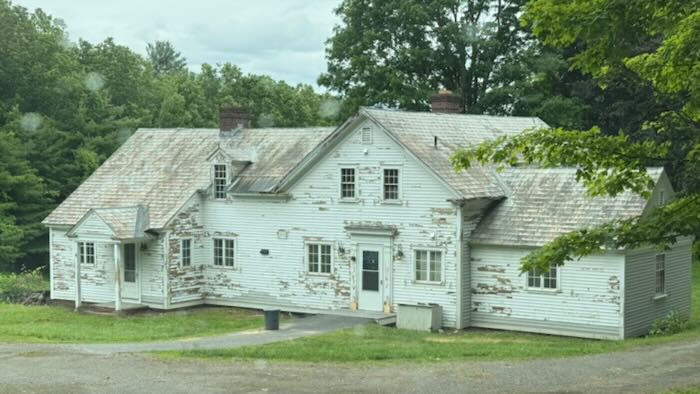
Kipling and Carrie visited Vermont as soon as they got married. Carrie’s family was based in Vermont. They then travelled through Canada to Japan. They had to return to Vermont when the bank where Kipling had his account folded up, and he had no money left for further travel. What stood out for me when I read his autobiography is that he neither mentions Carrie by name nor the town where they lived. Kipling was notoriously private about his life. His unfinished autobiography was published by Carrie a year after his death, but not before she had it edited to remove any vestiges of personal references. He and Carrie moved into a house called Bliss Cottage, paying a rent of $10 per month. He writes that in the winter of 1892, two sources gave him the inspiration for Mowgli and the jungle animals: a story about lions he had read in his childhood, and a phrase in Rider Haggard’s Nada the Lily.


Their daughter Josephine was born in late December 1892, and the next year they purchased ten acres of land on a rocky hillside. Angus Wilson, however, in his book The Strange Ride of Rudyard Kipling, mentions that the land was purchased from Carrie’s brother, Beatty, during their initial trip to Vermont. Kipling writes that a crew came over from Quebec in the summer and built a house which he christened “Naulakha.” It was a combination of American Shingle Style and an Indian Bungalow. He drew inspiration for the name from the seventeenth-century marble pavilion constructed by the Mughal emperor Shah Jahan in Lahore, which was reputed to have cost nau lakh, or nine hundred thousand rupees. 900,000 rupees was a large sum, but this was the same Shah Jahan who spent 32 million rupees to construct the Taj Mahal!
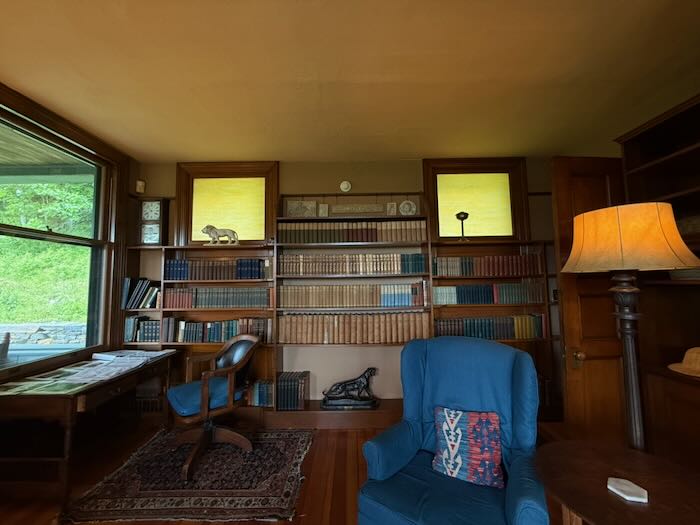
Our GPS instructed us to turn left on Kipling Road into a longish driveway that, Kipling mentions, required the use of dynamite to clear a path through the granite. We were pleasantly surprised to find a fair number of cars parked. We walked up the driveway to the house, which Kipling mentions was ninety feet in length, thirty in width, and built on a high foundation of solid, mortared rocks. We had purchased tickets online ($25 per head) and signed in with a volunteer at the entrance. I had expected a formal and closely guarded visit, but was pleasantly surprised that we were free to wander around the house and spend as much time as we wanted.

My raison d’être for visiting the house was to see the desk where Kipling wrote The Jungle Book, and I made a beeline for his study. My daughter took a more methodical approach, following the printed guide that was provided to us. I’m glad she did; she has a discerning eye, and many of the pictures I have included were taken by her. One has to pass through Carrie’s study before entering Kipling’s. Carrie was very protective of Kipling’s time and could be described as his gatekeeper. Apparently, the room was known as the “dragon’s chamber”! As I mentioned, Kipling does not refer to her by name, instead using the moniker “Committee of Ways and Means.” She took care of their finances and ran the household, leaving Kipling free to focus on his creative pursuits. Even though Kipling’s more famous novels were yet to be written, he was already doing very well on the royalties of his earlier works as well as his current work, and the spacious and beautifully laid-out house reflects this. Incidentally, Carrie maintained a diary that eventually ran to 13000 pages!
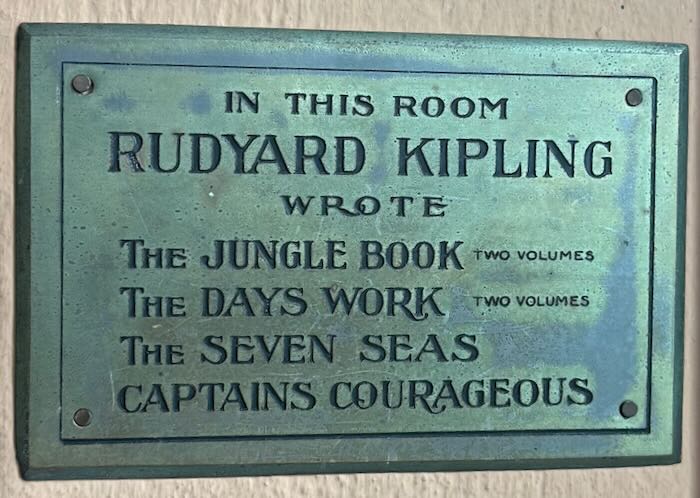
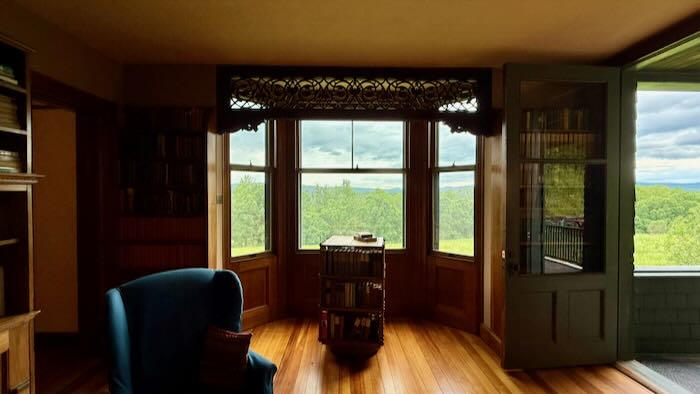
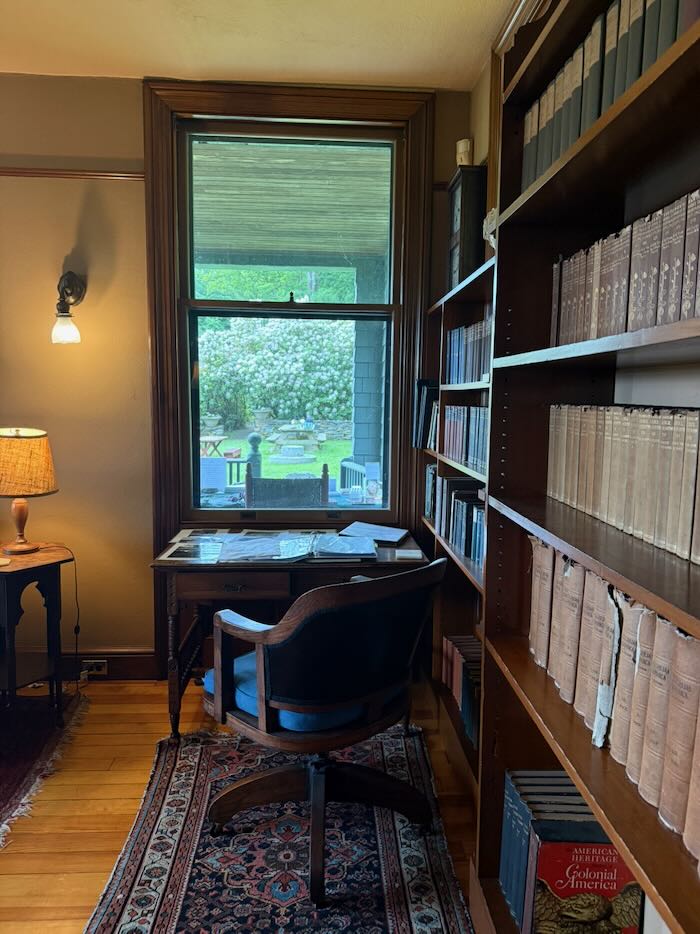
The study was as I had imagined it to be. The bookcases lining the walls are original, as is the revolving bookcase. There are several volumes of Kipling’s work, all published after his stay in that house. I spied more than one copy of the collected Sherlock Holmes. Lockwood Kipling, Rudyard Kipling’s father, inscribed the words “The night cometh when no man can work” (from the Gospel of St. John) over the fireplace. The study has large windows and is well illuminated. A bay window has a decorative screen, likely carved in Kashmir. The study has a plaque stating that Kipling wrote both volumes of The Jungle Book, The Day’s Work, The Seven Seas, and Captains Courageous in this room. The last is Kipling’s only American novel. However, the desk did not seem to match the pictures I had seen on the web. A staff member informed me that the original desk had been moved to the attic.

I made my way through the loggia, which offers a beautiful view of the vistas outside, and then into the dining room. The table and china cabinet are original. I presume Arthur Conan Doyle ate at that table; he visited the Kiplings in 1894, introduced Kipling to golf, and presented him with a set of golf clubs that are now housed in the small museum in the attic.

I wandered through the house, going through the bedrooms and the children’s nurseries. His second daughter, Elsie, was born at Naulakha. I must confess that I did not pay much attention to these rooms. The day nursery has decorative plasterwork crafted by Lockwood Kipling. The house was renovated by subsequent residents, the Holbrook family. I made my way up to the attic, which houses a billiards table that Kipling apparently modeled on one owned by Mark Twain.

The attic houses a small museum containing the golf clubs presented to Kipling by Arthur Conan Doyle. Also on display are plaster casts of Bagheera and Grey Brother, the wolf, presented to Kipling by Joel Chandler Harris, the author of the Uncle Remus stories, which Kipling had read as a boy and later read to his daughter Josephine. I chuckled when I saw these. I grew up enjoying Enid Blyton’s Brer Rabbit stories, which, of course, were based on the Uncle Remus stories. The museum also houses Kipling’s original desk, at which he wrote The Jungle Book. As I was looking around, my daughter joined me, and we admired the desk together. My mind drifted back to when she was just two years old, and the very first bedtime story I had narrated to her was from The Jungle Book; the Brer Rabbit stories followed later. We watched Disney’s The Jungle Book together several times, and I must admit it is among my favorite Disney movies. It is a different matter that the movie took artistic liberties with the story, and entire generations who have not read the book assume that the Disney version is true to the original.
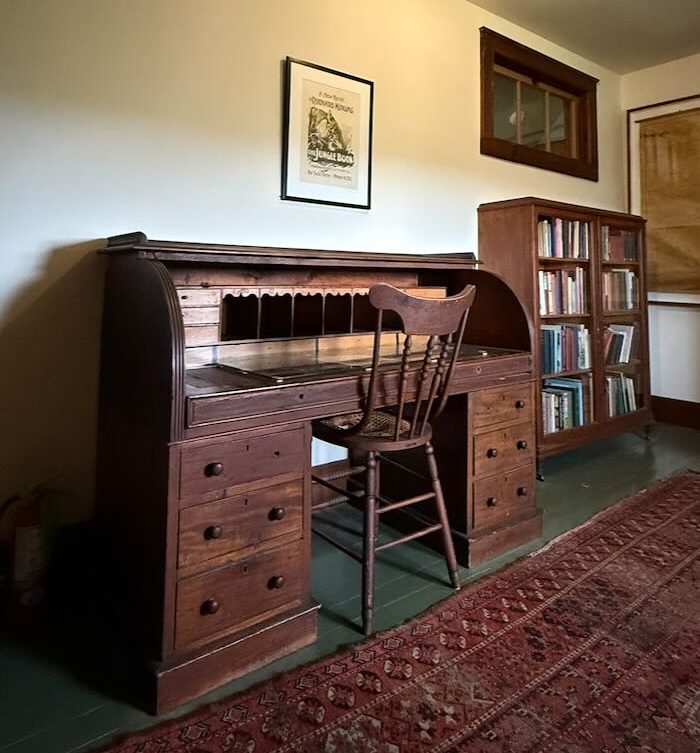
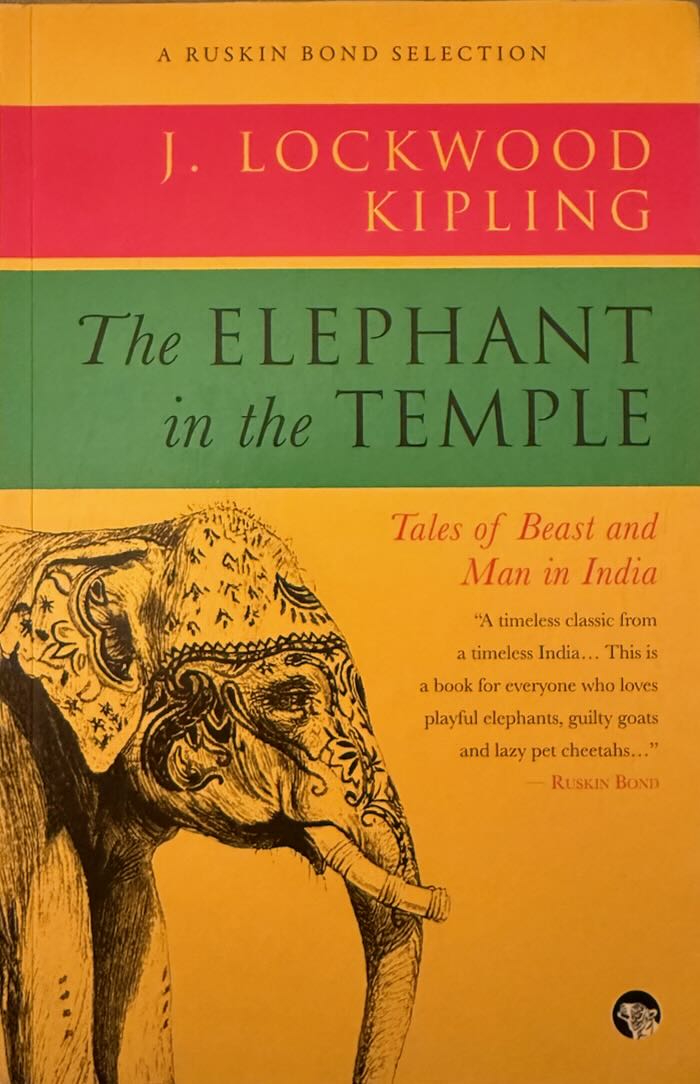
Kipling does not elaborate on The Jungle Book in his autobiography. Charles Allen, in Kipling Sahib, writes that the seeds for The Jungle Book were likely sown by the Jataka Tales, which Kipling would have encountered as a child, as well as during his years in Lahore. The Jataka Tales are a collection of stories from the Buddhist tradition that recount the previous lives of the Buddha, in which he appears in human and animal forms, each tale illustrating a moral virtue. Nada the Lily by Rider Haggard, which Kipling mentions in his autobiography, is based on a Zulu story of a wild boy who runs with a pack of wild dogs. The greatest influence, perhaps, was Lockwood Kipling, who arrived at Naulakha in the summer of 1893 with a large collection of drawings and Indian books. Lockwood Kipling had a naturalist’s eye for flora and fauna and was deeply steeped in Indian culture. The collaboration between father and son, and the exchange of stories and ideas around the fireplace in the study, no doubt contributed to the creation of The Jungle Book.

The property also has a carriage house that has been renovated to include two bedrooms. The stable that once housed his pairs of horses, Rod and Rick, Nip and Tuck, now has a well-appointed loft. These, along with Naulakha, can be reserved for overnight stays on The Landmark Trust USA website. At the carriage house, we fell into an interesting conversation with a volunteer and a couple who were discussing the Empire podcast episodes on Kipling. The conversation ranged over his life and works, and it was gratifying to find strangers connected by a shared interest in a remarkable author.

The four years that Kipling spent in Vermont were extremely productive. However, he writes that he was viewed unfavorably by his neighbors: “Here was a stranger of an unloved race, currently reported to make as much as a hundred dollars out of a ten-cent bottle of ink.” He describes the loneliness and sterility of life on the farms, noting that younger folk were moving out of Brattleboro in search of jobs, leaving older folk to manage the farms. Eventually, a domestic dispute with Carrie’s brother Beatty brought Kipling’s American stay to an end. The Kiplings had been supporting Beatty, who did not hold a steady job and was in debt. Carrie thought the best way to get Beatty to shape up would be to continue supporting his daughter but not him, forcing him to find work. An inebriated Beatty accosted Kipling while he was on a walk and threatened to kill him. Kipling reported the matter to the authorities, and Beatty was arrested. The ensuing trial, and the attention it attracted, proved too much for the intensely private Kipling, and the family left in 1896, never to return. Kipling’s autobiography was written about 40 years after he left Vermont; perhaps this bitter experience and later experiences might have colored his view of his stay in Vermont.

As I left, I could not help ruminating on what went through Kipling’s mind as he left Vermont. He would go on to write Kim and win the Nobel Prize in Literature. However, he would lose his daughter Josephine to whooping cough and his son John in the First World War, personal tragedies that he would not write about in his autobiography, though biographers note that he was never the same after Josephine’s death. Kipling was a vocal supporter of the First World War, exhorting the young to enlist and fight for Britain. One wonders whether he felt any guilt when his teenage son was killed within a month of being deployed to the front. He would be the toast of Britain, her unofficial poet laureate, and would count among his friends luminaries of the political and literary world, but would see his legacy tarnish even in his lifetime. In many ways, the four years he spent in Vermont were perhaps his happiest, at least when it came to his personal life. He may not have had a premonition of what lay ahead, but his parting words when he left New England were: “There are only two places in the world where I want to live, Bombay and Brattleboro, and I can’t live in either.”
If you are a Kipling enthusiast, Naulakha, the carriage house, and the loft in the stable can be rented for overnight stays. The annual open house is worth visiting; I found the staff and volunteers to be very cordial and helpful. The Trust has done a wonderful job of restoring these buildings. They also have some interesting memorabilia for sale at reasonable prices. It did strike me that most of the visitors were my generation or older. The only exposure to Kipling for the present generation is likely through Disney’s The Jungle Book; I am not sure how many people in the US read his books today. Many people are unaware that Kipling lived in Vermont and that The Jungle Book was written here. If you are planning a visit, do check out The Landmark Trust USA website for further information. A staff member at Naulakha kindly gave me directions to Bliss Cottage, the house the Kiplings rented when they first moved to Vermont. It is currently owned by the School for International Training and is located on their campus.
The featured image for this post is a watercolor card of Naulakha available for purchase at the open house.
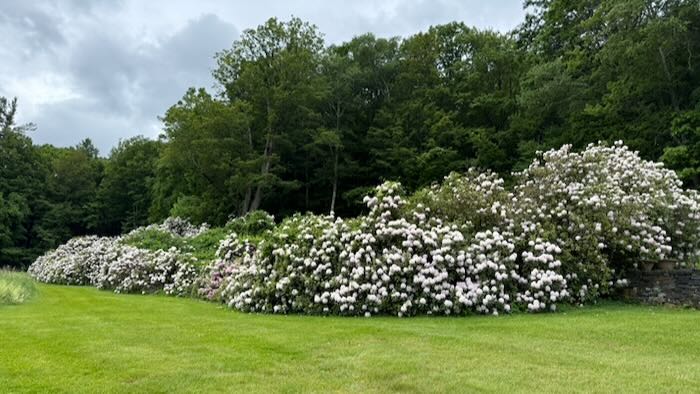
Here are some additional pictures

I had heard & read about this place long back.
You have described each & every details so well that it was as good as a visit to this place.
I have shared this with both my grandchildren who are Rudyard Kipling fans.
Continue giving us many more descriptions like this & save me of mt travel costs.
Pintumam
Thanks, Pintumaam! I hope your grandkids enjoy the blog and hopefully continue to read more Kipling!