
There was a clear bifurcation in the milieu in which the books that I read as a child were set. On one hand were the Amar Chitra Katha comics, which were set in India but mainly based on mythology and history, and then, there were comics such as Tintin, Asterix and Obelix, Phantom, etc., and books that I read, which were mainly set in the West. Indeed, there were very few novels and books that I read by Indian authors, and this is due to the fact that even though I speak three Indian languages, my reading has always been predominantly in English, and the vast vernacular literature was not accessible to me. This has been my loss and a cause of regret. There were stories and poems that we read in Hindi as part of our academic curriculum, but these were just a very small sliver of the literature that I read. However, there is a quartet of Anglo-Indian authors (that I grew up reading) whose books are set in India: Jim Corbett, Kenneth Anderson, Ruskin Bond, and Rudyard Kipling. Of these, the first two were not authors by training or profession, but their books became immensely popular, and the last two, of course, are celebrated authors.
I’ve read the entire Jim Corbett and Kenneth Anderson canon, but I’m working my way through Kipling and Ruskin Bond. Kipling’s works have especially surfaced during different phases of my life. My very first Kipling story was Rikki-Tikki-Tavi, which I read in a textbook at my mother’s aunt’s house when I was about nine years old. It was the only book available for me to read when I visited her house. I have forgotten the other stories, but Rikki-Tikki-Tavi stands out in my memory as it was set in India. My next encounter with Kipling came by way of the Cub Scouts and the Boy Scouts. Rudyard Kipling and Lord Baden-Powell, the founder of the scouting movement, were good friends. Cub Scouts were replete with themes from Kipling’s The Jungle Book. Cubs were members of packs and would cry out, “Akela! We will do our best!” Akela (from the Hindi “alone”) is the name of the pack leader in The Jungle Book. Kim’s Game is an observation and memory test, one of the many tests to acquire the Second Class badge. An assortment of items was placed on a tray, and we could study them for a couple of minutes before the tray was covered with a cloth. We then had to recall from memory the items on the tray. A skill taught to Kim by Lurgan Sahib as part of his training for the Great Game.
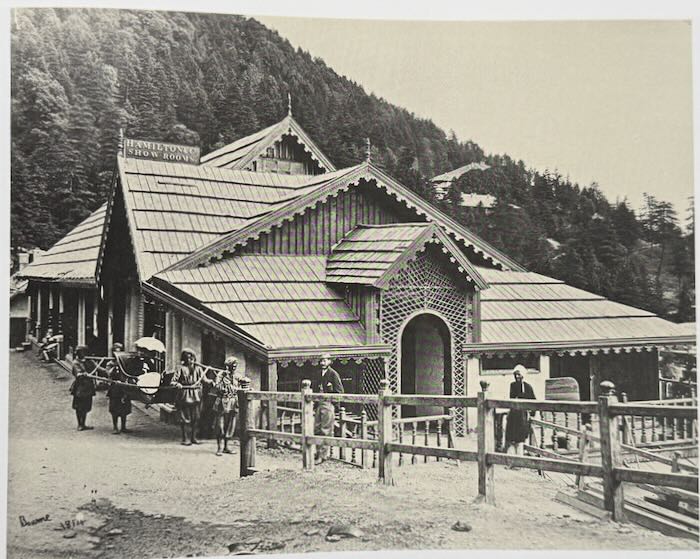
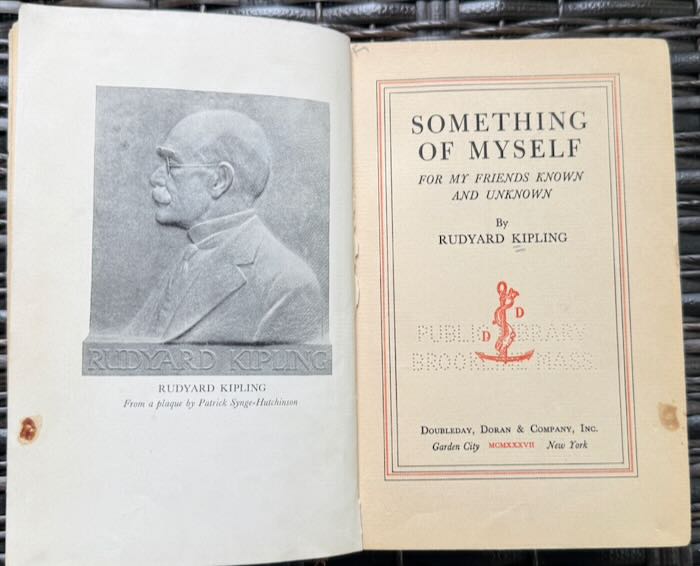
In his autobiography, Something of Myself, Kipling writes briefly about his childhood in India. He was born in Bombay, India in 1865, his parents having moved to India when his father took up a teaching position at the JJ School of Art in Bombay. He was named “Rudyard” after the lake where his parents met at a picnic. He recalls happy days spent with his Ayah (nanny) and other domestic help. As was customary in those days, he was sent off to England for school along with his younger sister, Trix. What followed was a period of physical and mental abuse at the hands of his foster family, a traumatic experience for a young boy who missed his parents and his home in India. He completed his schooling in England and returned to India to work as a journalist for the Civil and Military Gazette in Lahore, where his father had taken up the position of curator in the Lahore Museum. During the hot summers, the wheels of the British government machinery moved to the cooler climes of Simla in the foothills of the Himalayas. Kipling wrote Plain Tales from the Hills based on his observations of the society and characters in Simla (now known as Shimla). He was just 22 at the time of its publication. We had a copy at home, courtesy of a gift from my cousin Bakin.
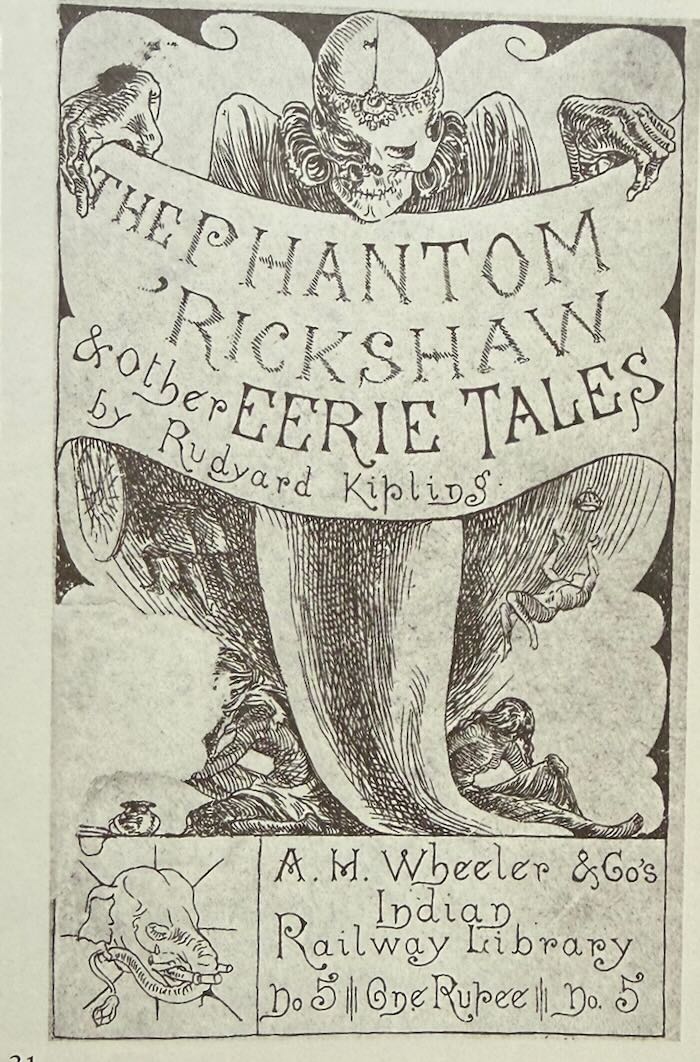
He then served a stint in Allahabad as the assistant editor of the newspaper The Pioneer for a couple of years. To pay for his expenses to return to England, he sold his stories to a publisher who published them as a series of paperbacks called the Indian Railway Library. Kipling returned to England in 1889 after spending seven years in India. He moved to Brattleboro, VT, in 1892 after his marriage to Caroline (Carrie) Balestier. They built a house that merged the American Shingle Style with the distinctive Indian Bungalow. He christened it Naulakha (nine lakhs) after the 17th-century Mughal Pavilion in Lahore. It was here that he wrote The Jungle Book and Captains Courageous. The family returned to England in 1896, staying briefly in Torquay (famously the setting of Fawlty Towers!) before eventually settling down in Sussex in a 17th-century house called Bateman’s. The family spent summers in South Africa for a few years, where he became friends with Cecil Rhodes. Kim, his most famous novel, was published in 1901. He was awarded the Nobel Prize for literature in 1907. He passed away in 1936, his autobiography unfinished. His ashes were interred in Westminster Abbey. I remember thinking that he was in illustrious company when I came across his memorial in Poets’ Corner, his neighbors being Charles Dickens and Thomas Hardy!
Kipling’s autobiography, published by his wife, Carrie, in 1937, has scant mention of his personal life. Indeed, Charles Allen in Kipling Sahib notes that it should have been more accurately called “As Little of Myself As I Can Get Away With.” There is no mention of the death of his daughter, Josephine, during a trip to America in 1899, a devastating loss that he never really recovered from. Neither is there mention of the tragic death of his son John in the First World War in 1915. I remember reading a poignant story in Reader’s Digest about a French soldier whose life was saved by a pocket-book copy of Kim, which deflected a bullet, saving his life by a mere 20 pages. On hearing that Kipling’s son John had been killed in the war, the soldier sent a copy of Kim with the embedded bullet, as well as his Croix de Guerre, to Kipling. Kipling accepted it on condition that he would return it if the soldier were to have a son, which he duly did, naming him Jean in honor of John, Jean being the French equivalent of the name. Kipling then returned the book and medal to him. It is now housed in the Library of Congress.
I read The Jungle Book and Just So Stories while growing up in India. We had to study his poem The Ballad of East and West in school for our ICSE exam. The opening verse is still fresh in my mind
Oh, East is East, and West is West, and never the twain shall meet,
Till Earth and Sky stand presently at God's great Judgment Seat;
But there is neither East nor West, Border, nor Breed, nor Birth,
When two strong men stand face to face, though they come from the ends of the earth!
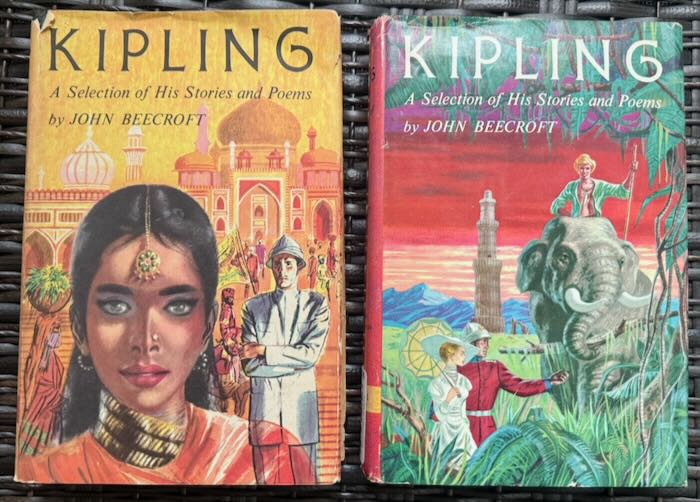
Over the years, I have collected a few of Kipling’s books, all bought at used book stores. I also have his complete works on Kindle, but there is a special charm to reading The Jungle Book in the sepia-tinted pages of an old hardbound. Indeed, reading the first edition of his autobiography (borrowed from a library) was a visual and tactile experience. The pages, yellowed, textured, and brittle, reminded me that this book was published just a year after his passing. An eReader could never evoke that emotion.
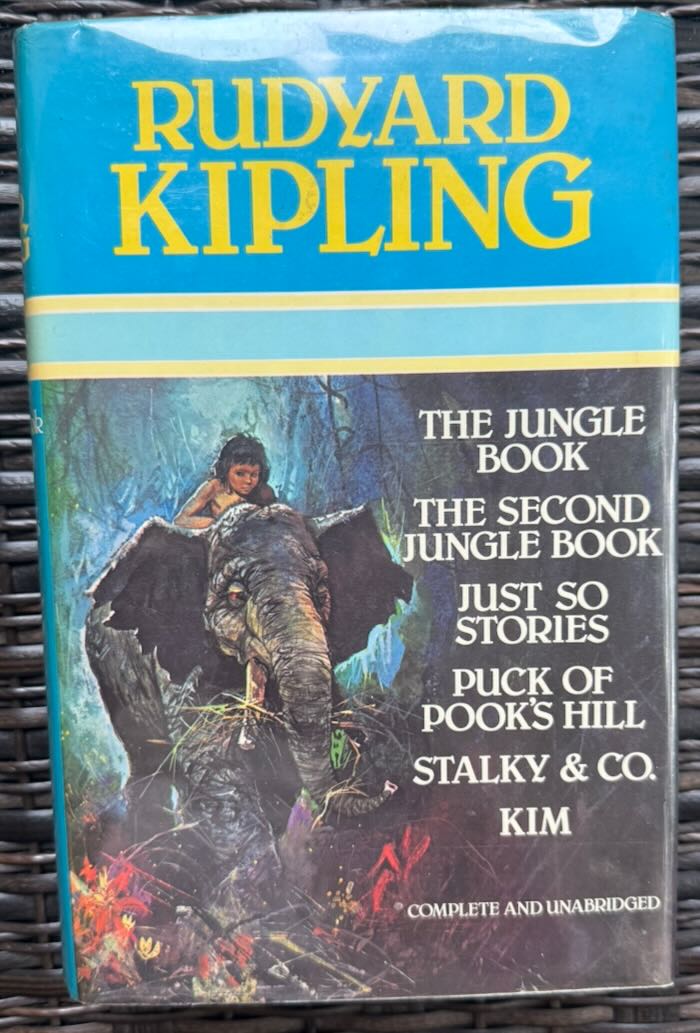
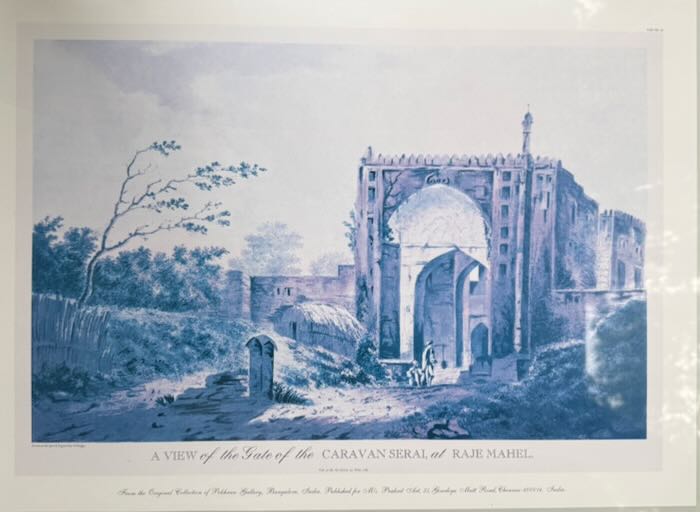
Oddly enough, I read Kim just recently. Kim, the novel’s eponymous character, is an Anglo-Indian orphan who befriends a Lama and accompanies him on his quest to find a mystical river. Along the way, Kim gets ensnared in the Great Game, and the novel ends with Kim joining the secret service. Kipling’s observations and character sketches are superb. His description of a serai (rest area) at sunset on the Grand Trunk Road, where Kim sets up camp with the Lama, is some of the most evocative writing that I have read. In fact, reading Kim now gave me a lot more insight and context for the book. Forty years ago, I would have reveled in the spirit of adventure. I still do, but I am now also struck by his mastery of language and visual imagery. Thanks to Bakin, I instantly recognized the character of Lurgan Sahib in Kim as being based on Alexander Malcolm Jacob. Bakin had gifted me The Mysterious Mr. Jacob (John Zubrzycki) a couple of years ago. The spies who were sent out as surveyors were men similar to the Pandits, like Kinthup, about whom I had read in Into the Silence (Wade Davis). Hurree Chander Mookerjee, or Hurree Babu, the Bengali intellectual and spy, likely had Sarat Chander Das as the inspiration. Bells of Shangri-la (Parimal Bhattacharya) chronicles his story. And yes, Bakin also recommended The Great Game by Peter Hopkirk. When I come to think of it, I am the grateful beneficiary of a superb collection of curated books gifted to me by Bakin, enough to fill a few bookshelves!
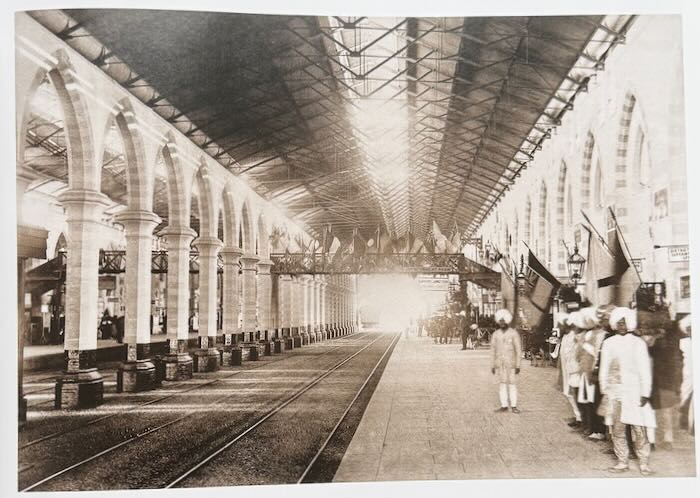
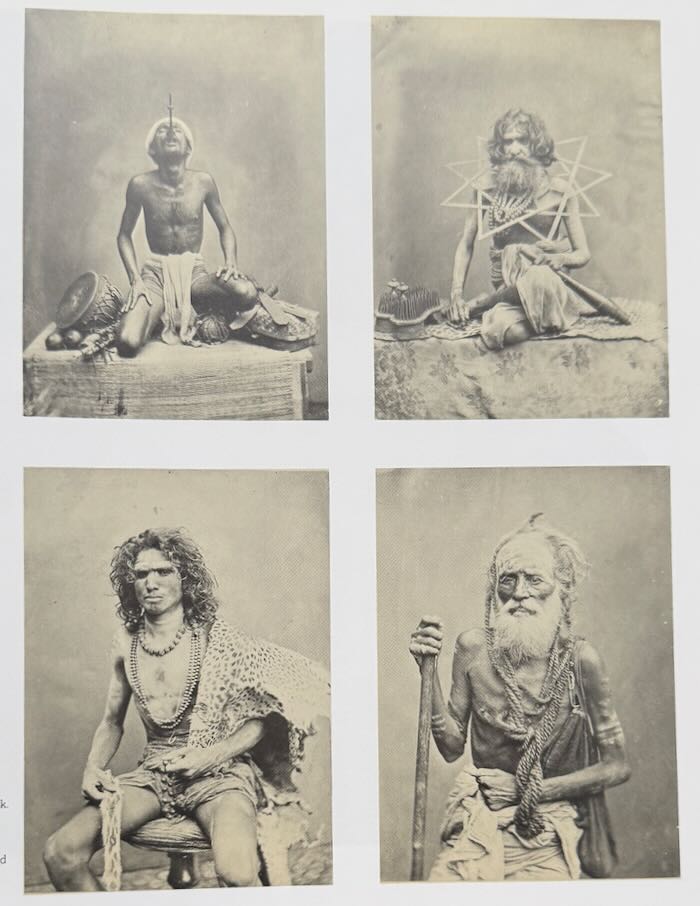
Kim was based on Kipling’s memories of India and, more specifically, on his father’s experiences and observations there. Kipling acknowledges his father’s contribution in his autobiography and also writes that his father refused any credit. Kipling’s writing easily painted a picture of the locales in my mind’s eye. I had some assistance, too. Over the years, I had bought some books with rare photographs of life in India during the British Raj. As I thumbed through the pages, I realized that the India Kipling saw and the one I grew up in were different in some respects but remarkably the same in others.
Kipling writes in his autobiography that he embarked on his book Rewards and Fairies partly to balance the “imperialistic” output of his past. It contained the poem If and in his own words, it “escaped from the book, and for a while ran about the world.” It is still running strong, it was voted the UK’s favorite poem in 1995. It happens to be one of my favorite poems. Kipling says he based this poem on the character of the colonial administrator Leander Starr Jameson. He leaves it at that. It turns out that Jameson had led the infamous “Jameson Raid,” a botched incursion into Boer territory to trigger an uprising of British settlers, destabilize the Boer government, and enable the British to take over the gold-rich region of Transvaal. The raid caused international embarrassment for Britain and led to his imprisonment. Kipling was impressed that Jameson accepted blame with stoic dignity. Ironically, the poem that I consider an ode to stoicism was written in honor of the stoicism displayed by an Imperialist! Regardless, the poem is inspirational. My brother pointed out to me that a copy of the poem is framed and mounted in each cadet’s room of the NDA (National Defence Academy) in India. He also mentioned that a couple of lines of the poem are engraved on the wall above the players’ entrance to Wimbledon’s Centre Court. And he remembered that it was also voted the US Congress’s favorite poem (in 1955). Yes, my brother is the third leg of the Kipling stool in our family!
There is no denying Kipling’s genius of imagination, creativity, observation, felicity of language, and turn of phrase. It is also hard to escape the fact that he was an unapologetic imperialist. His poem The White Man’s Burden is a case in point. Scholars debate the language used in his work; I think it was reflective of the writing of that time. What galls me is that Kipling publicly praised Reginald Dyer, hailing him as the “man who saved India.” This for a man known as the “Butcher of Amritsar” who gunned down over a thousand unarmed civilians at Jallianwalla Bagh. He also loathed Gandhi and the Indian Freedom Movement. His poem The Female of the Species was apparently aimed at the suffragette movement. His opposition apparently stemmed from his belief that women did not deserve to vote, as they did not serve in the military. He felt that giving women the right to vote would weaken the British Empire. His jingoism and full-throated support of the British Empire tarnished his legacy, even in his lifetime. During a conversation, Bakin, with his prodigious memory, quoted Angus Wilson’s observation that “the difficult truth is that aesthetic satisfaction is not one with ethical satisfaction.” All I can conclude is that, as Whitman said, people contain multitudes, and I have to separate his opinions from his literature.
And his literature does impress me. I marvel at people who write fiction and are able to conjure up fantastic tales that stir my imagination. Kipling does allude to the inspiration behind some of his stories. He mentions that as a child, he had read a tale about a lion hunter in South Africa who fell among lions who were Freemasons and entered into a confederacy against some wicked baboons. He says that the tale lay dormant in his mind until he wrote The Jungle Book. Kipling refers to his foster home as the “House of Desolation.” He says that the lies he had to tell at the age of seven or eight to avoid being bullied and beaten were, in a way, a foundation for literary effort. He writes that the notion for Kim came as early as his time in Vermont, yet it came to fruition a few years later when Kim came back with insistence, and he talked it over with his father. In his own words, “it grew like the Djinn released from the brass bottle, and the more we explored its possibilities, the more opulence of detail did we discover.” His father, Lockwood Kipling, was an accomplished artist who illustrated his son’s famous works, including The Jungle Book and Kim. The wise keeper of images of the Ajaib-Gher, the Wonder House, is no doubt based on his father, who was a curator at the Lahore Museum.
Kipling is among the most quoted English authors. “The female of the species is more deadly than the male,” “The White Man’s Burden,” “The law of the jungle,” “East is East and West is West, and never the twain shall meet,” “What should they know of England who only England know?” The last quote has been borrowed and adapted several times by others. I came across “What do they know of cricket who only cricket know?” in C.L.R. James’s Beyond a Boundary, not realizing that he was riffing on Kipling’s line. He was also a poet of repute. He turned down the honor of a knighthood as well as the British Poet Laureateship.

And that brings me back to my latest acquaintance with Kipling. Once a year, The Landmark Trust USA holds an open house at Naulakha in Brattleboro, Vermont. The town is a 90-minute drive from my house, and last Sunday, we drove up to take a look at the house. I had originally planned to end this blog with a brief description of my visit, but I think I have enough material to dedicate a separate blog to that! I will leave you with Sir Michael Caine’s reading of If. I can think of no better way to let Kipling have the last word.
I thoroughly enjoyed reading this post since I had a personal connection to your native land. Our trip to India in 2019 was made immensely more exciting because we spent the day in Mumbai with your cousin, Bakin, whom you mention multiple times. I can understand completely why you still enjoy your frequent conversations with him.
Even though you have lived in the US for so many years, you still have deep memories of Bangalore and Bombay (Bengaluru and Mumbai) where you spent your childhood and adolescence. It’s much the same for me when I connect with people on a Facebook page from my childhood in a small town in New Jersey. As I get older, I see that I’m getting more nostalgic. I can remember tiny details about places and people from the 50s and 60s.
Hi Dan, yes Bakin, with his encyclopedic knowledge is the perfect companion to visit Mumbai! I do get nostalgic about Bangalore. Honestly though, I miss the people I grew up with more than the place. It has changed significantly since in the last few years.